Mortgage Rates Moved Slightly Lower This Week | #GoodTimes #TalkToYourAgent #SiliconValleyAgent #YajneshRai #01924991 #YourAgentMatters #TeamYaj #SangeetaRai #02026129

Facebooktwitterpinterestlinkedin

Mortgage Rates Moved Slightly Lower This Week | Realtor Magazine

Mortgage rates for 30, 15, ARM. Full information at http://www.freddiemac.com/pmms/

® REALTOR® Magazine


Home buyers saw mortgage rates edge lower again this week, with rates remaining well below year ago levels. 

“Modestly weaker consumer spending and manufacturing data, along with continued jitters around trade policy, caused interest rates to decline throughout the yield curve,” said Sam Khater, Freddie Mac’s chief economist. “While signals from the financial markets are flashing caution signs, the real economy remains on solid ground with steady job growth and five-decade low unemployment rates, which will drive up home sales this summer.”

Freddie Mac reported the following national averages with mortgage rates for the week ending May 16:

  • 30-year fixed-rate mortgages averaged 4.07 percent, with an average 0.5 point, dropping from last week’s 4.10 percent average. A year ago, 30-year rates averaged 4.61 percent.
  • 15-year fixed-rate mortgages averaged 3.53 percent, with an average 0.4 point, falling from last week’s 3.57 percent average. A year ago, 15-year rates averaged 4.08 percent.
  • 5-year adjustable-rate mortgages averaged 3.66 percent, with an average 0.4 point, rising from last week’s 3.63 percent average. Last year at this time, 5-year ARMs averaged 3.82 percent.
Facebooktwitterpinterestlinkedin

5 DIY Ways to Increase Curb Appeal and Attract Buyers on a Budget | #CurbAppeal #TalkToYourAgent #SiliconValleyAgent #YajneshRai #01924991 #YourAgentMatters #TeamYaj #SangeetaRai #02026129

Facebooktwitterpinterestlinkedin

5 DIY Ways to Increase Curb Appeal and Attract Buyers on a Budget – Redfin Real-Time

Landscaping, lighting, power washing and more–5 curb appeal ideas from HGTV’s Chip Wade.


With its crisp air and lovely weather, spring is the optimal time to list your home. Assuming it’s primed and ready to be introduced to the public, that is.

In life and in home tours, first impressions are everything. Just as we embrace spring as a time to shed possessions that don’t bring us joy ala Marie Kondo, it’s also a time to spruce up homes both inside and out to help attract potential buyers.

Emphasis on ‘out’–exteriors are particularly important, says HGTV and DIY Network home expert and Liberty Mutual consultant, Chip Wade.

“In the springtime, we have what I call the swing vote of curb appeal. Homes with it hold a distinct advantage,” Chip said. “Public interest is focused on the exterior of a home and even an only okay property can explode with interest because of it. This can really flip the competition on its head.”

Chip, who has appeared on HGTV shows such as “Curb Appeal: The Block,” “Design Star,” and “Wise Buys,” spilled secrets and tips for easy spring DIY updates that will give your home curb appeal to attract buyers, without breaking the bank this spring.

1. Create a clearly defined entry path

“The front door is a moving target and not always right on the front of the house. We want to clearly identify and demystify the route our visitors take when they enter the property. If it’s walking down the driveway, make sure that is really clear with no searching around. Uncertainty of where to go creates a sense of confusion for visitors, which is the opposite of the reaction we want. Focus your budget first on making sure that entry point and the path to reach it is clear.”

2. Don’t neglect your mailbox

“The mailbox strongly relates to curb appeal. Updating it is one of the most cost effective ways to transform the first impression of your home in a big way. You can invest in a new one, or maybe all it needs is a fresh coat of paint or a marginal amount of landscaping. A mailbox with a pine straw bed and a nice clean edge next to your grass is a great first step with minimal effort.”

3. Focus on the front door

“Make sure the front door is representative of the quality you want your visitor to feel about the entire house. If you have a nice house but a hollow, flimsy front door with cheap hardware, the potential buyer sees and feels that first, setting a negative tone. If you have a really nice firm door with solid hardware, that can elevate the sense of quality about the entire house, even if it’s actually not as nice as some of the competition.”

4. Let there be light–especially outside

“The one thing that makes a home so much better is exterior lighting. A lot of people think outdoor lighting is difficult to install and only worth doing if you have a beautiful yard. Both of those things couldn’t be further from the truth. In fact, it’s an affordable, game-changing installation any DIY-er can do. Put in a simple, three-piece low-voltage system that plugs into any exterior outlet. You can do this for path lighting, uplighting and indirect lighting. 

Good lighting makes you want to spend time outdoors, is safer, and is also incredible for aesthetics. Just make sure you are getting bulbs that are all of the same color temperature. You’ll see a range between 2700 Kelvin to 5000 Kelvin. It doesn’t matter what you pick; warmer tones are lower numbers, but the same color temperature will make everything feel cohesive and look great.”

5. Discover the magic of power washing

“Spring cleaning doesn’t only refer to the inside of your house. Do a full cleansing of exteriors. If you’re not getting a pressure washer out once every spring, you’re wasting a golden opportunity to transform your property. Just about anything that might bring the feeling of a property down can be fixed with a pressure washer, from dirty sidewalks and siding, to cobwebs and mud splatters. If you don’t own one, rent it for $100 or buy a nice electric one that stays in the corner of your garage for $200. It’s a super versatile tool to wash exteriors, cars and kids toys.”

Facebooktwitterpinterestlinkedin

DIY Backyard Fire Pit: Build It in Just 7 Easy Steps | #BackYardFirePit #TalkToYourAgent #SiliconValleyAgent #YajneshRai #01924991 #YourAgentMatters #TeamYaj #SangeetaRai #02026129

Facebooktwitterpinterestlinkedin

DIY Backyard Fire Pit: Build It in Just 7 Easy Steps

Get ready

Before you begin building, consult your local fire code to see if fire pits are allowed in your city and, if so, how far away the fire pit has to be from a structure.

Then, gather your supplies:

  • Bricks for the fire pit wall
  • Gravel
  • Twine or string
  • Tape measure
  • Stake
  • Large shovel
  • Trowel
  • Tamp
  • Level

When purchasing bricks for the fire pit wall, go for something sturdy like retaining wall bricks or concrete pavers. Some home improvement stores even carry bricks specifically designed for fire pits. Use a layer of firebricks, which have a higher heat resistance, on the inner layer of the fire pit as an extra safety measure.

Now that you have all your supplies and you’ve checked your local fire code, you’re ready to build!

1. Create a circle

Pick a spot for your fire pit (ensuring that it is located a safe distance from any structures, bushes or trees) and insert a stake in the ground where the center of the pit will be.

Tie one end of the string or twine to the stake and measure how wide you want your circle to be.

Typically, a fire pit has a diameter of about 4-5 feet. Cut the string and tie the other end to the handle of a trowel. With the string or twine taut, drag the sharp end of the trowel around in a circle, creating a line in the grass.

2. Shovel out the grass

Using a large shovel, dig out the grass inside the circle.

For safety purposes, the hole for a fire pit should be about 6-12 inches deep. Be sure to call 811 before you start digging to ensure there are no utility lines buried under the spot you’ve chosen.

3. Tamp down the dirt

If you don’t have a tamp, you can just use the bottom of your shovel.

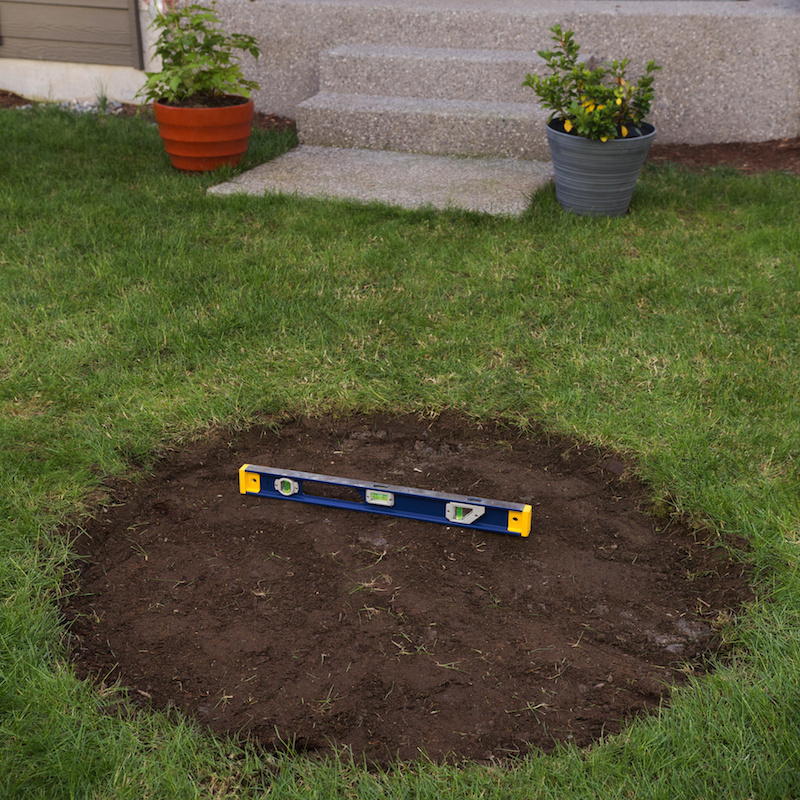
4. Make sure the circle is level

Get down on the ground with your level to ensure that the surface is ready for the bricks. Keep making small adjustments until it’s completely level.

5. Add gravel

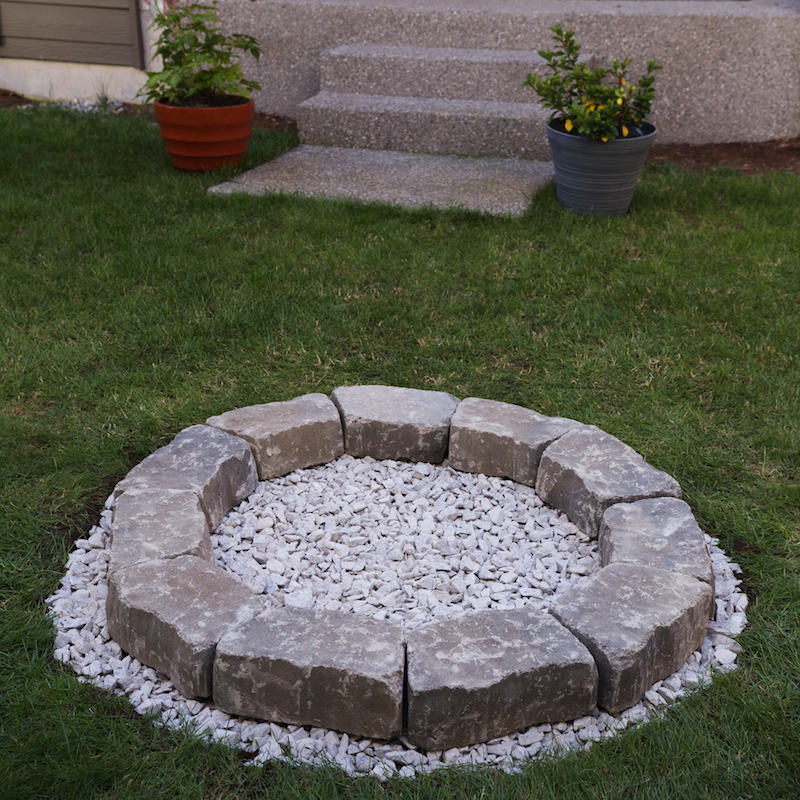
Put a pretty thick layer of gravel in the fire pit (at least a couple of inches). Spread the gravel around evenly.

6. Arrange the bricks

After you’ve spread the gravel around, arrange your bricks in a circle and stack them in layers until the fire pit wall is at least 12 inches tall.

For extra safety, you have the option to put an inner layer of firebricks. Though you don’t need to use mortar if the bricks are heavy enough to make a sturdy stack, you can use an outdoor fire-resistant mortar between the bricks for extra stability.

7. Relax and enjoy!

Gather a couple of Adirondack chairs, some firewood, a few friends and campfire treats to get full use out of your new fire pit.


Facebooktwitterpinterestlinkedin

Buyers Face Less Competition This Spring | #BuyerRelief #TalkToYourAgent #SiliconValleyAgent #YajneshRai #01924991 #YourAgentMatters #TeamYaj #SangeetaRai #02026129

Facebooktwitterpinterestlinkedin

Buyers Face Less Competition This Spring | Realtor Magazine

Home shoppers may be less likely to face a bidding war compared to a year ago. Just 15% of offers faced competition in April, according to an index by the real estate brokerage Redfin. That is down from 60% a year ago.

Even buyers in some of the hottest housing markets are reporting less competition this spring.

“Right now could be as good as it gets for buyers who want to avoid getting involved in bidding wars and price escalations,” says Daryl Fairweather, Redfin’s chief economist. “There are many forces at play that may lure buyers back and create more competition in the near future. Interest rates are low compared to last year, price growth has stalled and has even fallen in some West Coast markets, and wages are growing.”

San Francisco’s Bay Area remains the most likely market where buyers will face a bidding war. Twenty-two percent of offers in April there faced competition, which is still down significantly from 75% a year ago.

“Multiple billion-dollar San Francisco-based companies are going public this year, so I wouldn’t be surprised to see Bay Area bidding wars come back with a vengeance, pushing prices back up next year,” Fairweather says.

The next most competitive housing markets after San Francisco were Phoenix (20%) and San Diego (19%), according to Redfin’s index.


Redfin Bidding Wars chart. Visit source link at the end of this article for more information.

© Redfin


Overall, every metro area tracked by Redfin’s index saw a lower bidding war rate in April compared to a year ago. The least competitive housing markets in April were Miami (3%); Raleigh, N.C. (5%); Dallas (7%); Atlanta (7%); and Houston (7%).

Facebooktwitterpinterestlinkedin

Why Countertops, Flooring, Lighting Costs Are Rising | #RemodelingCost #TalkToYourAgent #SiliconValleyAgent #YajneshRai #01924991 #YourAgentMatters #TeamYaj #SangeetaRai #02026129

Facebooktwitterpinterestlinkedin

Why Countertops, Flooring, Lighting Costs Are Rising | Realtor Magazine

Those wanting to spruce up a home may need to add more money to their budget. Builders and contractors are warning that new tariffs on Chinese goods will add $2.5 billion in added costs to the home remodeling industry, and those extra costs will be passed on to customers.

Tariff costs on Chinese imports jumped from 10% to 25% on May 10, which builders say will increase the cost of about 450 goods used by the home building industry, such as countertops, like granite, marble, and quartz, tile for bathrooms and backsplashes, light fixtures, cabinets, heating and cooling equipment, and flooring.

“I wish we would not just have to pass it along to customers, but at this point I don’t know how to engineer around that,” Bruce Case, CEO of Case Remodeling, told CNBC. “We can’t use different products that aren’t as effective.”

The White House has increased tariffs on $200 billion worth of Chinese imports, including $10 billion of goods used by the homebuilding industry. U.S. and Chinese officials ended two days of trade talks without a deal on Friday. China was the United States’ biggest trading partner last year.

Last week, a survey from the National Association of Home Builders also showed that a labor shortage continues to impact housing projects by increasing prices and delaying timetables. Remodeling jobs that involve carpenters, framing crews, bricklayers, and electricians are seeing some of the largest shortages.

“The labor shortage continues to be one of the top concerns for remodelers across the country,” says Tim Ellis, the NAHB’s Remodelers chair. “An ongoing challenge for remodeling is keeping their prices competitive while dealing with the increasing costs of labor.”

From half to 70% of the remodelers surveyed by the NAHB reported that the top effects of the labor shortage have been higher wages and subcontractor bids, higher prices for customers, and difficulty completing projects on time, and some have even had to turn down some projects because of it.

Facebooktwitterpinterestlinkedin

Asian Americans Are a Rapidly Growing Buying Force | #AsianBuyers #TalkToYourAgent #SiliconValleyAgent #YajneshRai #01924991 #YourAgentMatters #TeamYaj #SangeetaRai #02026129

Facebooktwitterpinterestlinkedin

Asian Americans Are a Rapidly Growing Buying Force | Realtor Magazine

The Asian American and Pacific Islander demographic could be poised to become the nation’s largest minority group over the next few decades, according to the 2018-2019 State of Asia America report produced by the Asian Real Estate Association of America, in conjunction with RE/MAX and Freddie Mac. The population’s close family ties, high education, entrepreneurial spirit, and higher household incomes are expected to have a big impact on the U.S. economy and housing market, the report says.

AAPIs also comprise some of the largest gains among any other minority group in homeownership, the report shows. They tend to live in multigenerational homes, with researchers noting that their homeownership numbers may be skewed lower  because of that.

“The report highlights the growing power and influence of the AAPI community—the fastest-growing population in the United States,” writes Mike Reagan, senior vice president of global alliances at RE/MAX LLC. “Real estate professionals who take time to learn more about the unique needs and challenges of the AAPI community position themselves to provide better service and more value to customers.”

Between 2000 and 2015, the AAPI population grew by 72% in the U.S. The population is outnumbering Hispanic-Americans, the report notes. U.S. Census Bureau and Nielsen reports project that by 2055, AAPIs will become the largest minority group in the country due to immigration and domestic growth. The AAPI demographic is diverse and represents more than 50 ethnicities.

AAPIs’ higher incomes and rates of education, higher credit scores, and low loan-to-value and debt-to-income ratios make them particularly well-positioned to become homeowners, the report notes. AAPIs continue to take out the largest loan amounts of any ethnic group, with average home purchases of more than $390,000. The average loan amount for AAPI buyers has risen nearly 40% from 2004 to 2017, the report shows.

Relocating to the South

The AAPI population is increasingly heading to the South, while the Midwest is the second-fastest-growing region.

The growth of Asian populations in the South has been significant, the report notes. Along with a combination of immigration, relocations, and new births, AAPI populations grew nearly 70% between 2000 and 2010 in the Southern region of the U.S., according to the report. Some of the fastest growing AAPI populations are in North Carolina and Georgia, which respectively saw an 89.5% and 85.6% population increase between 2000 and 2012. Texas is also seeing significant growth, though behind other states like California and New York.

Homeownership Barriers Do Exist, However

The number of AAPI home buyers has increased 27% since 2001. However, their numbers still lag behind other groups. In the fourth quarter of 2018, the non-Hispanic white homeownership rate was 73.6%, compared to 58.1% of Asian, native Hawaiian, and Pacific Islander; the rate for blacks was 42.9% and for Hispanics was 46.9%, according to the report.

“High incomes and rates of education, high credit scores, and low loan-to-value and debt-to-income ratios make AAPI typically well positioned to be homeowners,” according to the report. “However, AAPI homeownership still falls behind national average and significantly behind non-Hispanic whites. Many reasons contribute to this, including language barriers, lack of knowledge, and lack of education in the homebuying process.”

Facebooktwitterpinterestlinkedin

Mortgage Rates Post Another Drop This Week | #GoodTimes #TalkToYourAgent #SiliconValleyAgent #YajneshRai #01924991 #YourAgentMatters #TeamYaj #SangeetaRai #02026129

Facebooktwitterpinterestlinkedin

Mortgage Rates Post Another Drop This Week | Realtor Magazine

Mortgage rates for 30, 15, ARM. Full information at http://www.freddiemac.com/pmms/

© REALTOR® Magazine


Mortgage rates are showing signs of moderating this month, following increases in April. Borrowers are discovering much lower rates compared to a year ago.

“A combination of low mortgage rates, a strong job market, and modest wage growth should spur home buyer interest and also serve as an incentive for homeowners looking to refinance this spring,” says Sam Khater, Freddie Mac’s chief economist.

Freddie Mac reports the following national averages with mortgage rates for the week ending May 9:

  • 30-year fixed-rate mortgages: averaged 4.10%, with an average 0.5 point, falling from last week’s 4.14% average. Last year at this time, 30-year rates averaged 4.55%.
  • 15-year fixed-rate mortgages: averaged 3.57%, with an average 0.4 point, falling from last week’s 3.60% average. A year ago, 15-year rates averaged 4.01%.
  • 5-year hybrid adjustable-rate mortgages: averaged 3.63%, with an average 0.4 point, falling from last week’s 3.68% average. A year ago, 5-year ARMs averaged 3.77%.
Facebooktwitterpinterestlinkedin

Survey: Consumers Say Owning Is Easier Than Renting | #BuyingEasier #TalkToYourAgent #SiliconValleyAgent #YajneshRai #01924991 #YourAgentMatters #TeamYaj #SangeetaRai #02026129

Facebooktwitterpinterestlinkedin

Survey: Consumers Say Owning Is Easier Than Renting | Realtor Magazine

A majority of homeowners recently surveyed say they believe owning a home isn’t as difficult as renting, according to a new survey from LendingTree, an online loan marketplace. Only 15% of homeowners believe renting is easier than owning a home, compared with 67% of more than 2,000 homeowners who said owning is easier, the survey found.

For the most part, the longer homeowners have been in their homes, the more likely they are to believe owning is easier, according to the study. For example, nearly 72% of homeowners who have spent seven to nine years in their home say owning is easier than renting.


LendingTree owning easier than renting chart. Visit source link at the end of this article for more information.

© LendingTree


The longer a consumer owns a home, the less likely they’ll say they ever want to rent again, the survey found. Only 7% of respondents who have owned their home for at least a decade say they wish they could return to renting, compared to 19% who have owned for three years or less.

Homeowners seem happy and content, particularly in some states. Missouri has the largest percentage of homeowners—91%—who say they’ll stay in their state after 10 years. Tennessee and Georgia homeowners are also likely to say they don’t plan to move to another state in the next decade.

On the other hand, homeowners in the Northeast are the most likely to say they want to relocate to a different state. Homeowners in Maryland, Massachusetts, Illinois, New Jersey, and Connecticut may be among the most transient and open to moving to another state, the study found.


Lendingtree homeowners likely to switch states in 10 years. Visit source link at the end of this article for more information.

© LendingTree


Facebooktwitterpinterestlinkedin

There Could Be a Problem With ‘Multigen’ Homes | #MultiGenHomes #TalkToYourAgent #SiliconValleyAgent #YajneshRai #01924991 #YourAgentMatters #TeamYaj #SangeetaRai #02026129

Facebooktwitterpinterestlinkedin

There Could Be a Problem With ‘Multigen’ Homes | Realtor Magazine

Housing is poised for a significant redesign from a growing number of households looking for properties that accommodate multiple generations under one roof. Up to 41% of Americans in the market to buy a home say they’re considering accommodating an elderly parent or an adult child, according to a new survey from John Burns Real Estate Consulting. That will likely influence the homes they choose to buy.

However, the current housing stock is dominated by single-family homes that aren’t designed to fit multiple generations living in the same home.

Homes designed for multigenerational living is a small segment of the housing market today. Some families have renovated their homes to accommodate aging parents or aging children.

Some major homebuilders have been responding with multiple-generation floor plans that make space for three or more generations in one household. For example, in 2011, Lennar began offering its Next Gen brand under the tag line, “Two homes. Under one roof.” It offers models of its Next Gen line of homes in 13 states.

A multigenerational home typically consists of separate entrances and garages and is often presented as having an “in-law” unit. Those units usually have their own kitchen and living spaces, too.

Architects say that the design of housing will need to respond to accommodate the changes in households. In 1980, only 12% of Americans lived in a multigenerational household, but that has now grown to 20%—or 64 million—of Americans who have two or more adult generations in a single household, according to the Pew Research Center.

Americans are living longer—now to the average age of 78. The cost and isolation of living alone may be prompting more families to come together.

“The emphasis on physical and financial independence at every stage of adulthood has high incurred costs,” Fast Company reports. America’s current housing stock, however, has centered on independence and privacy, which doesn’t quite fit the merging of households.

“I think there’s a tighter connection just generationally between young adults and their parents,” says Chris Porter, an analyst at John Burns Real Estate Consulting who tracks housing trends. That connection is prompting changes in senior housing. “We’re seeing the golf course as less of an amenity these days for senior housing. The real amenity for seniors is being near their kids and grandkids. I think that comes back to that connection between the boomers and their kids.”

But when living in a multigenerational household isn’t an option, cohousing may be. Cohousing is also growing in the U.S. The term reflects a group of private homes that share community spaces and resources. It can take many forms. But one way it’s growing is through senior-focused cohousing, which offers seniors the ability to age in place and also serves as an alternative to senior-living complexes. There are more than 170 cohousing communities in the U.S.

Many changes will likely influence American neighborhoods going forward, but the impact of meeting the needs of aging-in-place and multigenerational households is a pressing one, researchers say.

“American cities and suburbs will need to undergo a radical change in response to climate change, shifting away from single-family homes and toward denser housing typologies, away from personal vehicles and toward public transit, walkability, and shared cars, away from independence and towards resource sharing. Ironically, we stand to benefit from those changes as we age,” Fast Company reports.

Facebooktwitterpinterestlinkedin

Top 10 Tech Features Buyers Want | #TodaysBuyer #TalkToYourAgent #SiliconValleyAgent #YajneshRai #01924991 #YourAgentMatters #TeamYaj #SangeetaRai #02026129

Facebooktwitterpinterestlinkedin

Top 10 Tech Features Buyers Want | Realtor Magazine

Buyers are showing more interest in technological home features, with 46% of new and prospective homeowners saying, for example, that they want a security camera on the premises, according to the National Association of Home Builders’ latest annual survey, What Home Buyers Really Want.

Three of the four most-wanted tech features are related to security, with surveillance cameras leading the pack, the survey shows. Buyers also reported high interest in video doorbells and wireless home security systems. But while at least 40% of home buyers say they want these tech features, only about 21% currently have them—“indicating that there is a market growth potential for these items,” the NAHB notes on its blog, Eye on Housing.


NAHB tech chart. Visit source link at the end of the article for more information.

© National Association of Home Builders

Facebooktwitterpinterestlinkedin