California home prices on track to hit a record high in 2018, Realtor forecast says | #Solid2018ForCARealEstate #TalkToYourAgent #SiliconValleyAgent #YajneshRai

Facebooktwitterpinterestlinkedin

California home prices on track to hit a record high in 2018, Realtor forecast says – Orange County Register

California’s five-year run of rising home prices is expected to last another three to five years, with median house prices on track to beat the record highs set during the housing bubble, a Realtor economist said Thursday, Oct. 12.

The California Association of Realtors forecast home prices will increase an additional 4.2 percent in 2018, rising to $561,020. If the forecast proves accurate, that existing single-family home price will exceed the record high of $560,270 set in 2007. Prices, however, will remain well below pre-recession records when taking inflation into account.

Single-family home sales also are projected to increase in the state next year, but at a much more modest pace, the Realtor forecast said. CAR projected 426,200 houses will change hands, up 1 percent from this year’s level.

Overall, the gains in both house prices and sales are lower than in past years, perhaps signaling the California housing market’s “rate of acceleration has been slowing,” said CAR Chief Economist Leslie Appleton-Young.

Southern California home prices are expected to rise at roughly the same pace in 2018 and to match the statewide median, Appleton Young said.

The big mystery in the housing market, however, is why the pace of sales and price growth isn’t higher given that jobs and incomes have been rising. The answer lies in twin ills that have plagued the housing market for the past four years: Too few homes for sale and too few buyers able to afford those that are on the market at today’s prices.

“It’s so odd to look at this in an environment where you’ve seen such rapid job growth and income growth and low (mortgage interest) rates,” Appleton-Young said. “A lack of inventory and affordability … are really keeping a lid on the California housing market. We have fewer transactions … today than when we had 10 million fewer people living in California.”

Pulling out an old economics lesson, Appleton-Young noted that high home-price appreciation usually leads to “a supply response” — that is, more homeowners taking advantage of higher prices.

“We just haven’t seen that happening,” Appleton-Young said.

The reason, she said, is home sellers face possible consequences after big price gains. Not only do they lose their Prop. 13 tax advantages when they move, they also can face a capital gains tax on profits that exceed $250,000 for individuals and $500,000 for married couples.

Meanwhile, buyers are constrained as well, the economist noted. Rents have been rising so fast that few millennials can save up for a down payment to buy a home.

While half of Californians could afford the median-priced house when the market recovery started in 2012, only 26 percent will be able to afford a detached, single-family home next year, the forecast said.

A lack of homes for sale — due in part to underbuilding — has become the new norm, Appleton-Young said. But the scarcity is most pronounced for lower-priced, entry-level homes for first-time buyers.

“The low end is kind of disappearing,” she said. “It pushes people inland. It pushes people out of state.”

CAR also expects mortgage interest rates to rise slightly next year, but not enough to deter homebuyers. Rates for traditional 30-year, fixed mortgages are forecast to rise to 4.3 percent in 2018. That’s still low compared with historical averages but up from 4 percent this year and 3.6 percent in 2016.

If rates were to go much higher, “housing will be hit hard,” Appleton-Young said. She doesn’t expect that to occur, however. Instead, Appleton-Young expects home prices to continue rising for the next few years.

“I know that this cycle will not last forever,” Appleton-Young said. “I would guess we’ve got maybe three to five more years where things can eke out the kind of increases that we’ve seen over the past couple of years.”

Facebooktwitterpinterestlinkedin

6 Tips on How to Get Your Home Ready for Sale | #HomeSellingTips #TalkToYourAgent #SiliconValleyAgent #YajneshRai

Facebooktwitterpinterestlinkedin

6 Tips on How to Get Your Home Ready for Sale | RealtyBizNews

Here is how:

  1. Un-personalize the house

This is what other people call disassociating yourself with the house. To do this, you will need to learn how to let go. This is because un-personalizing your home means removing pictures and other items of sentimental value to your home. Packing away your family heirlooms and will be difficult but essential.

If there are built-in items you want to take with you, remove or replace them.

  1. De-cluttering

Every home has loads of junk. For example if you are a tutor, you will have to get rid of the notes you no longer need. Consider this, if you haven’t used it in the past year, you don’t need it; so, you can donate it or even throw them away.

Pack away your knick-knacks, remove books from the bookcases, pack essentials in a small box and clean out everything from the kitchen counters.

  1. Reorganize storage cabinets and bedroom closets

Buyers will snoop in your house, and you want everything to appeal to them. The organization of the storage cabinet and the bedroom closets say a lot about your neatness and the care your home received.

For spice jars, arrange it in alphabetical order and stack dishes away neatly. The cups’ handles should all face the same direction, shoes lined and shirts hanged together.

  1. Rent a Temporary Storage

You probably have loads of extra and unnecessary furniture. Since you want your home to sell fast, you’ll have to keep it as neat as possible. Spaces look better with less furniture so, you should stow away the extra furniture in storage. You can put away the bookcases too leaving the house with just what you need. Less furniture also makes the purpose of the room clear.

You should also keep away some clothes – all homes have extra clothes that aren’t worn, and they will only make your closet look disorganized.

  1. Light up the house

Lighting is one of the biggest selling points for homes. So, you should let in more light by pulling down the drapes, changing the lampshades and clean the windows. You can also increase the wattage of your bulbs. If there are bushes outside the house, cut or prune them to let in more light. A sellable house is a cheery house.

  1. Conceal all critters

Though dogs and cats are adorable, they aren’t a favorite to everyone. That means that not everyone will appreciate the wagging tails, smelling litter boxes or bowls of dog food. In most cases, these make your home appear dirty, and it won’t sell. So, you should send critters to the pet hotel for a day.

Final Thoughts

You’ll need to be ready to show the house and the how should be show-ready as long as it is on the market. Stripping the home-feel from the house is critical. Finally, first impressions, especially in the kitchen matters.

Facebooktwitterpinterestlinkedin

What Home Insurance Doesn’t Cover | #UnderstandHomeInsurance #TalkToYourAgent #SiliconValleyAgent #YajneshRai

Facebooktwitterpinterestlinkedin

What Home Insurance Doesn’t Cover | Realtor Magazine

A home insurance policy won’t cover every thing that could possibly go wrong with a home. The details are all in the fine print within the policy.

“Insurance policies are like snowflakes; no two are exactly the same,” Ashleigh Cloud Trent, an insurance adviser with Swingle Collins and Associates in Dallas, told realtor.com®.

Many standard policies do not include a few things that homeowners may assume they cover. Homeowners may need to investigate supplemental coverage. Here are a few common things that aren’t covered by homeowners insurance:

Home renovations

Homeowners will need to take out a specific renovation policy if they’re doing major work to their home. A renovation policy will cover potential liability issues, such as if someone gets hurt on your property during the remodel. “It’s OK if you’re just doing cosmetic updates; but if you’re taking the roof off, that’s more than a standard homeowners policy is designed to protect,” says Trent.

Earthquakes and floods

Homeowners will need to get earthquake insurance if they want to be protected. Standard homeowner coverage isn’t usually protective from damage in earthquakes, leaving you paying for repairs. Floods aren’t often covered in standard insurance policies either and require supplemental insurance.

Slow water leaks

Damage from “seepage and leakage” can also be denied for coverage. Water damage usually has to be “sudden and accidental” to be covered, Trent says. Trent offers up one example: A client whose contractor nicked a pipe behind a wall. The pipe was connected to a seldom-used guest bathroom, so nobody noticed the leak. When they rented out the home years later, the tenants called a few months later to report that the floorboards were warping. The damage was $25,000, and the homeowners insurance wouldn’t pay any of it.

Smell damage

Most policies won’t cover smells that linger around your home and possessions. We had a client in the process of renovating a home who put all of their belongings in a storage unit that happened to be right next to a restaurant, says Trent. When he went to get his things back, all his possessions, including his mattress, permanently smelled like curry.

Sewer and drain backups

Homeowners may also be stuck with the bill if their sewer backs up into their home. In a lot of places, when there’s serious rain, the sewers and drains can back up into people’s homes, says Trent. Not all policies will cover that.

Facebooktwitterpinterestlinkedin

4 Social Benefits of Homeownership | #HomeOwnersBenefits #TalkToYourAgent #SiliconValleyAgent #YajneshRai

Facebooktwitterpinterestlinkedin

4 Social Benefits of Homeownership | Realtor Magazine

Improved educational performance, higher civic participation, lower crime rates, and improved health remain the biggest social benefits linked to homeownership, according to a new research paper by NAR Chief Economist Lawrence Yun and research economist Nadia Evangelou, which appears in The Journal of the Center for Real Estate Studies. Some findings from the latest research cited in the paper include:

Health. Children of homeowners tend to be happier and healthier than children of nonowners, even after factoring in income and education levels. More recently, studies have found the wealth-building effect of homeownership and the sense of control it often brings in a stable housing market can positively affect homeowners’ mental and physical health. On the other hand, some studies suggest that areas where housing distress is high tend to see greater rates of mental health and stress-related health diagnoses among residents.

Crime. Research has confirmed homeowners have a lower instance of involvement in crime than nonowners. Also, neighborhoods with stable housing options—regardless of ownership structure—are more likely to have lower crime rates. Some studies have found, however, that foreclosure levels do influence burglary and violent crime rates.

Education. Researchers have found homeowners tend to accrue more wealth and save more money—such financial practices are associated with lower rates of homeowners’ children dropping out of school.

Civic engagement. Homeownership and residential stability continues to be linked with an increased likelihood of electoral participation. Homeowners remain more likely to participate in local elections and civic groups than renters, the paper states.

“Owning a home embodies the promise of individual autonomy and is the aspiration of most American households,” the researchers note. “Homeownership allows households to accumulate wealth and social status, and is the basis for a number of positive social, economic, family, and civic outcomes.”

Facebooktwitterpinterestlinkedin

Staging Is Key in Home Sales | #StagingIsKey #TalkToYourAgent #SiliconValleyAgent #YajneshRai

Facebooktwitterpinterestlinkedin

Upscale Staging Is Key in Luxury Condos | Realtor Magazine

Looking to get your listing noticed on the higher end of the market? Condo developers in this segment say they lure affluent buyers with models that feature brand-name goods and high-end finishes.

“You want customers to daydream a little bit. Everyone always buys what they see,” Alexander Hovnanian, developer of Nine on the Hudson, a 13-story luxury condo under construction in New Jersey, told The Wall Street Journal. The building’s units will range from about $675,000 to $6 million.

Developers are carefully outfitting models with features such as custom-designed closets, one-of-a-kind artwork, designer light fixtures, and top-notch luxury goods that promote a lavish lifestyle.

Designers do have to make some assumptions when staging luxury units. For example, they’ve found that younger buyers tend to prefer smaller units with pared-down modern furnishings and bright colors. On the other hand, larger units often will include more traditional interiors to attract buyers who are downsizing from a larger home, Highlyann Krasnow, principal at the Design High, an interior design firm based in New York, told The Wall Street Journal.

The idea that staging can make a difference is backed up many agents and brokers outside of the design community. Thirty-one percent of buyer’s agents say that staging a home can increase its value by up to 5 percent, according to a recent survey of nearly 2,000 agents by the National Association of REALTORS®

Buyers who peruse a staged model unit may be able to make their buying decision faster because it can even evoke feelings of happiness, says Stephen Conroy, an economics professor at the University of San Diego who studies real estate amenities. When buyers can see a unit in person rather than try to visualize it on paper, the experience of seeing and feeling the various finishes offers up “an emotion that’s going to enter into the buying decision,” Conroy told The Wall Street Journal.

Facebooktwitterpinterestlinkedin

New-Home Sales Hit 10-Year High | #ShortageBumpsNewSales #TalkToYourAgent #SiliconValleyAgent #YajneshRai

Facebooktwitterpinterestlinkedin

New-Home Sales Hit 10-Year High | Realtor Magazine

Sales of newly built single-family homes rose 18.9 percent last month, according to data from the U.S. Department of Housing and Urban Development and the U.S. Census Bureau. This represented the highest sales rate since October 2007, with a seasonally adjusted annual rate of 667,000 units, after an upwardly revised August reading. Compared to last year, new-home sales are 8.6 percent above their level during the same period in 2016.

“New-home sales have bounced back from a few soft months and have returned to the strong growth trend we saw earlier this year,” says National Association of Home Builders Chief Economist Robert Dietz. “As existing home inventory remains tight, we can expect new homes sales to continue to make gains in the months ahead.”

These gains in sales continue alongside tight inventory, providing downward pressure on affordability. In a recent REALTOR® Magazine column, National Association of REALTORS® Chief Economist Lawrence Yun urged the industry to recognize the impact that the “massive housing shortage” has on the overall the economy: “We need more construction. An economic boom, not unlike the one we had almost 70 years ago, could result.”

Looking deeper into the sales data, realtor.com Chief Economist Danielle Hale noted a contrast between pricing and the amount buyers ultimately pay for new homes. “The growth in prices for new homes also shows signs of slowing, though that hasn’t yet appeared in home listing prices, which are up 10 percent from a year ago,” she says. “The discrepancy between list price increases and sales price increases suggests that some buyers may have reached a limit on the price increases they can afford, but sellers have not yet caught on.”

New-home sales increased in all four regions, rising 33.3 percent in the Northeast, 25.8 percent in the South, 10.6 percent in the Midwest, and 2.9 percent in the West. Home sales in the South had been greatly hampered by hurricane-related setbacks. All regions showed an increase in sales from last month, and all regions except the Midwest also show growth when compared to a year ago.

Facebooktwitterpinterestlinkedin

5 Painting Mistakes That’ll Show | #PaintingTips #TalkToYourAgent #SiliconValleyAgent #YajneshRai

Facebooktwitterpinterestlinkedin

5 Painting Mistakes That’ll Show | Realtor Magazine

Painting can be one of the most cost-effective ways to spruce up a listing. But homeowners can also make a lot of mistakes with this common DIY job. Realtor.com® recently spoke with staging and color experts to find out some of the most obvious mistakes that they see most often.

1. Choosing the wrong finish.

Homeowners need to select a paint finish that correlates with the room’s purpose. “Many homeowners are nervous about using shiny semigloss, but it’s more durable than flat or matte and more moisture-resistant, which makes it perfect for bathrooms and the kitchen,” Kristen Chuber, marketing director at Paintzen, told realtor.com®. However, flat and matte finishes may make better choices for high-traffic areas like hallways or kids’ rooms, since they usually allow for easier touch-ups.

2. Not paying attention to the room’s undertones.

Pay close attention to the other elements of the room that can influence how the color looks on the walls. “Your color will look off if you pair a pink undertone with a yellow one, so look at the counters, the stone fireplace, and cabinets when choosing paint,” Karen Gray-Plaisted, a home staging expert with Design Solutions KGP, told realtor.com®. The flooring can influence the color perception too. For example, a warm mahogany hardwood might look strange when paired with a cool gray paint, Gray-Plaisted says. Also, be sure to “test your color swatches in different lighting, or you’ll end up with a shade that’s all wrong,” Chuber notes.

3. Selecting the wrong color of white.

White paint comes in many shades. “Some whites are cool, others warm, still more are neutral, so the one you pick will depend on the room’s finishes and undertones,” Gray-Plaisted says. Liat Tzoubari, CEO of home decor boutique Sevensmith, told realtor.com® she sees homeowners overuse white paint in a home. “Instead, choose a white with a slight pink or yellow tint, such as cream,” she suggests.

4. Forgetting about what’s overhead.

Ignoring the ceiling when repainting can make the room appear dull and dirty, says Chuber. “Whether you pick white or a bright color, painting it properly will give you those sharp edges along the top and can make wall color pop,” Chuber says.

5. Adding an accent wall in an odd place.

Adding a pop of color to an accent wall is a popular move, but homeowners should make sure the effect isn’t jarring. “Accent walls are supposed to draw attention to a beautiful area, like the dining room—but not the bathroom or toilet area,” Kaitlin Willhoit, a real estate pro with The Boutique Real Estate Group, told realtor.com®. Also, the paint chosen for the accent wall needs to still work with the overall color scheme of the room or the house, says Bee Heinemann, interior designer with Vant Wall Panels. Too bright or too bold a color may be a turnoff to buyers.

Facebooktwitterpinterestlinkedin

Survey: Buyers Leery of Online Mortgage Info | #OnlineMortgageInfo #TalkToYourAgent #SiliconValleyAgent #YajneshRai

Facebooktwitterpinterestlinkedin

Survey: Buyers Leery of Online Mortgage Info | Realtor Magazine

Consumers trust real estate professionals and lenders more than online sources or family and friends when it comes to obtaining information about mortgages, according to a new Fannie Mae survey based on 1,000 responses. Recent home buyers surveyed, including younger age groups, say they consulted multiple sources of information about the mortgage process but found lenders and real estate agents to be more credible than mobile apps, websites, and social media.

Though survey respondents say online sources are more convenient, they indicated a higher level of confidence in getting information through person-to-person interaction. However, home buyers do report using online sources to shop for a home much more often than to shop for a mortgage, according to the survey.

Facebooktwitterpinterestlinkedin

Large Yards May Soon Be The Thing of the Past | #ThinkingLargeYards #TalkToYourAgent #SiliconValleyAgent #YajneshRai

Facebooktwitterpinterestlinkedin

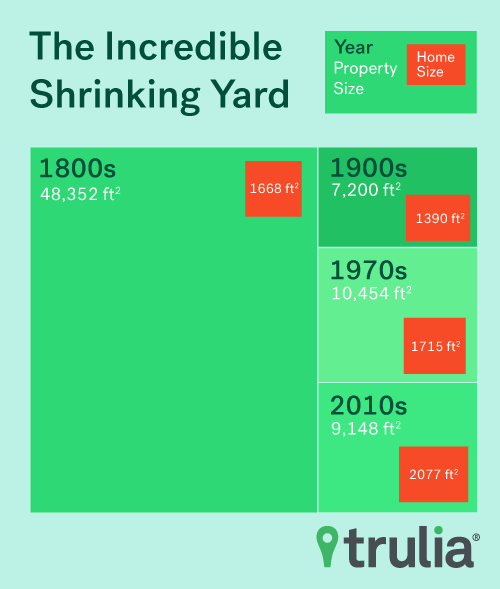
The Incredible Shrinking Yard! – Trulia’s Blog

The size of new homes has been growing for decades now, but it’s coming at the expense of yard space

America’s homes are getting bigger, but more space comes at a price: the backyard.

New single family homes are using land relative to home size at near-record levels, even after considering the number of stories homes have.

It’s a trend that has been taking shape for much of the past three decades as lot sizes continue to shrink and home square footage continues to grow. Homes built since 2015 occupy 25% of the land on which they sit, while homes built in 1975 occupy just 13.9%.

Many people like the idea of living in a single-family home and having a yard to call your own along with some space between themselves and their neighbors. In fact, surveys suggest that even city dwelling millennials aspire to a more traditional American dream of living in a large home in the suburbs and mowing their lawn on weekends. Nearly half, 46% of millennials, would prefer to move into a larger home compared with just 13% who would like to downsize.

Not only does where you live play a big role in how easy it will be find a place to live large inside and out, more importantly, when homes were built will have a big impact on how great of backyard barbeque you can actually hold.

Here are some key takeaways from our analysis:

  • Nationally, single family homes occupy 17.4% of the lots on which they sit, regardless of the year they were built.
  • Homes built since 2015 occupy 25% of the land on which they sit, while homes built in 1975 occupy just 13.9%. This is being driven by a combination of lots shrinking by 36.2% and home footprints growing by 15.2% size.
  • Meanwhile, some of the oldest homes in the country, built in the early 1800s, occupy less than 5.0% of the large lots they are built on. The last time lot usage was nearly as high as it is now was during the early 1900s.
  • Don’t mind the neighbors? Single family homes in places like Philadelphia, and San Francisco, which are both geographically small but dense, have the highest lot utilization at 57.7%, and 44.2%, respectively.
  • Want plenty of yard space? Head to New England. Three Connecticut metro areas, Worcester, Mass., Hartford, Conn., and Bridgeport, Conn. make up the places with the smallest amount of house occupying lot space, at less than 7.5%.
  • While most metro areas have seen lot usage grow since the mid-70s, with Oakland, Calif., and Miami seeing the largest upward swings, six metros have bucked the trend with San Francisco, Memphis, and Long Island, N.Y. moving toward less lot usage.

Lots Keep Shrinking and Homes Keep Growing


As America moved to an industrial economy from an agrarian one, the size of single family homes’ footprints generally fell to 1,420 square feet in the early 1900s from 1,740 square feet for homes built in the early 1800s. At the same time, the typical lot size on which they were being built decreased in size to 6,860 square feet, or 0.16 acres in the early 1900s from a median of roughly 56,000 square feet, or around 1.25 acres. This dramatic fall in lot sizes, paired up with a more modest decrease in the size of houses’ footprints resulted in a steady increase in lot usage from less than 4.0% to more than 21.5%.

After that though, the trend reversed for a while, with home and lot sizes increasing in tandem from the 30s through much of the 1970s – the age of suburbs – with the median lot size growing to 12,430 square feet


(0.3 acres) and the median home footprint growing to 1,824 square feet. Home and lot growth during much of this period were partially spurred by the post war economic boom, the relatively new ubiquity of automobile use which allowed people to live further from dense urban areas, and was all punctuated by the building out of the Interstate Highway System, which made far-flung places less far flung.

The rise of suburbs brought lot usage down to 14.5% for that decade. Since then, however, while the size of home footprints has continued to grow, lot sizes first stopped growing, then began shrinking again in early 1990s. For homes built since the start of 2015, the estimated footprint is 2,113 square feet (down from an all-time high of 2,125 in 2014) while the lot they are built on has shrunk to 8,940 square feet, or 0.2 acres, bringing lot usage up to a near-record high of 25%.

A Day in the Park vs. A Day in the Yard

Among places with the tightest lots, most have seen an unusually high proportion of their building occur during periods when tighter lot construction was the norm. In addition to San Francisco and Philadelphia, places like Chicago and Detroit all have among the highest proportion of their housing stock built between 1890 and 1929, which was the first time lot usage peaked. Other places near the top of the list, like Las Vegas and Phoenix, have had among the highest portion of their housing stock built after 1996.

There are still many places where newly constructed homes still have plenty of free space, despite the national trend. All four Connecticut metros in the analysis are among the top 10 places for plenty of lot space overall. Even just looking at homes built after 2014, Worcester, Mass., Hartford, Conn., Bridgeport, Conn., and New Haven, Conn., are all places where a home’s footprint take up less than 10% of the lots on which they sit. Still looking at only homes built since the start of 2015, New England metro areas in general seem to be leading the nation in minimizing lot usage, though this is not the case when considering all homes in these places, regardless of when they were built. Providence, R.I., Cambridge, Mass., Albany, N.Y. and Boston are also bucking the national trend with newly constructed homes occupying less than 10% of their respective lots, though these places all have slightly higher lot usage for their housing stock overall.

Facebooktwitterpinterestlinkedin

Remodeling Activity to Spike Through 2018 | #HomeOwnersRemodelling #TalkToYourAgent #SiliconValleyAgent #YajneshRai

Facebooktwitterpinterestlinkedin

Remodeling Activity to Spike Through 2018 | Realtor Magazine

As homeowners gain more equity, they are expected to continue heavily investing in home improvement projects and repairs through the third quarter of 2018, according to the latest Leading Indicator of Remodeling Activity report released by the Joint Center for Housing Studies of Harvard University. The LIRA index projects annual gains in home renovation and repair spending of 6.3 percent for the fourth quarter of 2017 and up to 7.7 percent by the third quarter of next year.

“Recent strengthening of the U.S. economy, tight for-sale housing inventories, and healthy home equity gains are all working to boost home improvement activity,” says Chris Herbert, managing director of the Joint Center for Housing Studies. “Over the coming year, owners are projected to spend in excess of $330 billion on home upgrades and replacements, as well as routine maintenance.”

Abbe Will, a research associate in the Remodeling Futures Program at JCHS, says that recent hurricanes and other natural disasters have the potential for strengthening remodeling activity even more over the next year than forecasted. Major reconstruction and repairs will get underway in affected regions and likely lead to elevated activity, Will says.

For homeowners looking to remodel for resale, the National Association of REALTORS® publishes a report looking at the costs of some of the top remodeling projects. Take a look at the 2017 Remodeling Impact Report.


Facebooktwitterpinterestlinkedin