3 Ways to Keep Cool Without AC | #HomeOwnerTips #ShareInformation #TalkToYourAgent #YajneshRai

Facebooktwitterpinterestlinkedin

3 Ways to Keep Cool Without AC | Realtor Magazine

Over 100 million Americans are expected to face a massive heat wave this weekend, and it’s always a good idea to remind people living in older housing stock without air conditioning that there are easy ways they can stay cool even during the peak of summer temperatures.

Houselogic recently shared some tips on how to beat the heat:

Say no to sunlight. The first thing to do when temperatures rise is to limit the amount of sunlight into the home. Closing all of your home’s blinds and drapes is an easy and effective fix to stay cool without AC. You can also buy high-reflectivity window film and put it on the home’s east and west-facing windows.

It may be worth it to install awnings on your home. According to Houselogic, awnings will “reduce solar heat gain by up to 77 percent.” You can also DIY an awning by putting up sheets outside your windows, which may not be aesthetically pleasing but it is effective.

Get that air circulating. When living without air conditioning in the peak of summer heat, fans will be your best friend. An easy quick fix is to buy portable fans of all sizes and place them in the windows at night and wherever you need them the most during the day. You can add to the fun by putting bowls of ice water directly in front of the fan, which will give the blowing air a nice chill.

If you need long-term fan solutions, consider buying ceiling fans or even a whole house fan, which will set you back  $1,000 to $1,600, including the installation. When using a whole house fan, keep in mind you have to keep your windows open.

Turn off appliances. It sounds simple, but it’s true: even powering-down the appliances you’re not using can cut the heat in a home. You’ll also want to refrain from using appliances that generate the most heat during the time of day when its the hottest.

Facebooktwitterpinterestlinkedin

Ways to prep your kitchen before selling your home | #GetTheRightAdvice #TalkToYourAgent #GreatRealtor #YajneshRai #ShareInformation

Facebooktwitterpinterestlinkedin

Ways to prep your kitchen before selling your home – Starts at 60

If you’re thinking of listing your home, one area you’ll want to play close attention to is your kitchen. In case you weren’t aware, kitchens sell houses.

However, that doesn’t mean you need to knock it out and replace it. A simple upgrade to your kitchen’s finishes and ensuring that the space available is set out properly could see your home move from ‘For Sale’ to ‘Sold’ quicker than you think.

Here are eight simple ways you can prep your kitchen for sale.

1. Consider the wood look
If your floors need replacing, hardwood is the go-to when it comes to adding value. But hardwood can also be expensive, so the way to get around this is to choose a less expensive flooring that has the wood look like vinyl or tile that can carry a lower price tag.

2. Paint
If your cabinets are looking old or out of date, giving them a lick of paint will ensure they impress a potential buyer. Cabinets are often the first things buyers see in your kitchen, so making sure they are in tip-top shape is important.

Completely replacing your cabinets them might set you back thousands of dollars, so a DIY paint job might be the way to go (and there are lots of options available here). Not confident to do it yourself, a professional will cost you some money so be sure to get quotes and find the best deal.

In terms of colour, consider a simple white. It is a timeless choice with broad appeal and it keeps your kitchen space looking light and airy.

3. Replace your cabinet hardware and tap fittings
These are such a minor upgrade, but it can boost your kitchen’s appeal immensely. Depending on the type of finish you choose, you can get away with this upgrade for less than $1,000. Stainless steel and chrome finishes are incredibly trendy options, but something that complements the style of your kitchen will work best.

4. Solid surfaces
Home buyers want solid and durable kitchen work surfaces. Granite, quartz and Caesarstone are all quality products. Laminate is still a good option, but can look dated so you might want to consider an upgrade. Be prepared to spend a bit more on a solid countertop. Laminate is by far the cheapest with prices as low as $230, but something like granite or marble is roughly $750 per square-metre, while something like Caesarstone could cost you a minimum of $1,500. There are cheaper options like bamboo, glass and stainless steel. Again, choose a style that fits with the rest of your kitchen.

5. Have a decent splashback
If you’re still looking at the same splashback that featured in your kitchen when you first moved in the ’70s, ’80s or ’90s now is the time to upgrade. There are much more stylish and modern options available in splashbacks using mosaic tile or glass, stone and even stainless steel you should consider. Ordinary glass could set you back as little as $300 per square-metre, but if you want something cheaper consider tin panels ($120/sqm), hardboard ($80/sqm) or tiles ($27/sqm).

6. More paint
Running a roller over the walls in your home should be one of the first jobs you consider tackling when looking to sell your home. Kitchen walls need to be presentable too. The recommendation here when it comes to colour is sticking with something neutral, and the lighter the better — especially if you have a small kitchen.

7. Upgrade the lighting
If you want to create an open and inviting space, swap the dim and/or broken bulbs for new ones and if you have pendant lights or lamps, be sure they fit with the style of your kitchen as well as today’s trends.

8. Presentation is everything
All the upgrades and improvements to the finish of your kitchen won’t mean much if your buyer can’t see themselves in the space. You want to keep your kitchen as clean as possible, especially if there is an inspection coming up. Be sure to:

  • Clear counters and remove items you no longer use from the pantry and cupboards
  • Improve your kitchen’s flow by looking at the way tables, chairs and decor are presented. You want it to feel open, not cramped
  • Use fruits and fresh flowers to decorate the area
Facebooktwitterpinterestlinkedin

The Very Worst Home-Pricing Advice You’ll Ever Hear (and Why) | #HireTheBest #GreatRealtor #YajneshRai #ShareInformation

Facebooktwitterpinterestlinkedin

The Very Worst Home-Pricing Advice You’ll Ever Hear (and Why) – Real Estate News and Advice – realtor.com

When it comes to selling your house for top dollar, good advice is as priceless as a vintage bootleg of “Abbey Road.” But bad advice from well-intentioned friends and family can seem a bit more like unearthing an old mixtape from an ex: deeply personal and more than a little warped.

To help you fast-forward past misconceptions, half-truths, and outright falsehoods, we’ve compiled a list of the very worst home-pricing advice you might actually hear someone say. Be sure to nod, then run in the opposite direction. Run fast.

‘Price the house based on what you feel is right’

Why you might hear this: Nobody but you knows that it took you forever to lovingly nurture those dahlias in your front yard into the best on the block. So naturally you, and only you, know what your home is truly worth.

Why it’s bad advice: A home’s list price should be based on hard facts such as comps and square footage. While your home may have a plethora of lovely intangibles, don’t let emotion cloud what is essentially a very large and important business transaction. Ask your Realtor® for guidance and information to help you home in on the right price.

“The broker should supply a fully thought-out pricing opinion,” says Kathy Braddock, managing director of William Raveis in New York City.

———

‘Price the house based on what you paid, plus a little extra for profit’

Why you might hear this: Everyone wants to sell a home for a profit, right? That’s what home selling is all about.

Why it’s bad advice: Sorry, what you want doesn’t really matter in this scenario—the only thing that does is what a buyer is willing to pay. And that will be based on the comps, or what similar-size homes in your area sold for recently, says Braddock. And that figure is what the asking price should be based on. Got it?

———

‘Add the cost of renovations you’ve made to your price’

Why you might hear this: It took you the entire summer—and tons of cash—to lovingly rehab that kitchen. But hey, all that money, and maybe more, should be recouped when you sell, right?

Why it’s bad advice: While your home may have numerous lovely improvements, this doesn’t necessarily mean buyers want to pay for them. Sure, they may foot some of the bill for those new countertops or the swimming pool you added, but not all.

In fact, according to Remodeling Magazine’s 2016 Cost vs. Value Report, you’ll make an average of 64% profit on what you paid for a renovation when you sell your home. And the return on investment varies based on what you’ve done, so be sure to do the math rather than just slap the full price of those renovations onto your asking price.

———

‘Not in a hurry to sell? Price the home high’

Why you might hear this: Much like Sleeping Beauty, you have time to wait. And someday your realty prince will come—in the form of a fat offer.

Why it’s bad advice: To appropriate the lyrics of a classic Otis Redding song, houses they do get weary—”market weary,” that is.

“If a home is substantially overpriced, it’ll end up sitting on the market for a long time,” says Atlanta-based Realtor Bill Golden, with Re/Max Metro Atlanta Cityside. Once that happens, buyers get wind of the stagnating house and will make lower offers. “In the end, these homes almost always sell for less than if they had priced it right to begin with.”

———

‘Price your home high, because buyers will come in low’

Why you might hear this: We’ve all been to yard sales. The price tag on that cool chair may say 10 bucks, but we know the owners will actually take 8. Same principle applies to houses, right?

Why it’s bad advice: This may be one of the very worst pieces of home-selling advice of all time. When a home is priced too high, you exclude possible buyers and eventually will have to lower the price. This ends up “making you look desperate as a seller,” says California Realtor Tracey Hampson. As noted above, sellers need to price their home according to past sales of homes within their area that have similar square footage. “If a home is priced correctly, you will get full-price offers and even over-asking-price offers.”

———

‘If you get a lowball offer, don’t even bother to try negotiating’

Why you might hear this: Someone who comes in way under the asking price just doesn’t have enough dough to ever afford your home. And frankly, certain offers are insulting.

Why it’s bad advice: “If there’s one thing I’ve learned over 30 years of selling real estate, it’s that everyone has different styles of negotiating,” says Golden. Some buyers are bargain hunters prone to making lowball offers. And Golden has seen deals come together even when the initial offer was “completely ridiculous.” Besides, a seller has absolutely nothing to lose by making a counteroffer, even if it’s at full price.

Facebooktwitterpinterestlinkedin

Builders, Investors Optimistic about Real Estate Market | #ShareInformation #TalkToYourRealtor #NewConstruction #YajneshRai

Facebooktwitterpinterestlinkedin

Builders Ramp Up Production This Summer | Realtor Magazine

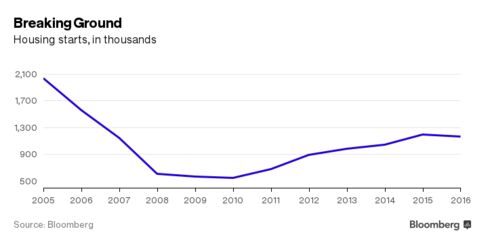
Builders are finally adding more homes into the pipeline. Housing starts across the country rose in June, ticking up 4.8 percent month over month to a seasonally adjusted annual rate of 1.19 million units, the Commerce Department reports. Permits, a sign of future construction, also rose, up 1.5 percent in June, and is at a seasonally adjusted annual rate of 1.15 million units.

“This month’s uptick in production is an indicator that the housing market continues to move forward,” says National Association of Home Builders Chairman Ed Brady. “At the same time, builders are adding inventory at a cautious pace as they face lot shortages and regulatory hurdles.”

Single-family housing starts climbed 4.4 percent in June to a seasonally adjusted annual rate of 778,000 units. Multifamily production rose 5.4 percent to 411,000 units.

“The June report is consistent with our forecast for a gradual but consistent recovery of the housing market,” says Robert Dietz, chief economist of the NAHB. “Single-family production should continue to strengthen throughout the year, buoyed by job growth, new household formations, and low mortgage interest rates.”

By region, single- and multifamily housing starts posted the highest month-to-month gains in the Northeast, rising 46.3 percent in June, followed by a 17.4 percent increase in the West. On the other hand, the Midwest registered a 5.2 percent decrease in starts last month, while the South saw a 3.4 percent drop. Despite the overall drops, all regions of the country saw an increase in single-family production.

Facebooktwitterpinterestlinkedin

Buying Or Selling Home Soon? | Avoid Identity Theft | #BeCareful #ShareInformation #YajneshRai

Facebooktwitterpinterestlinkedin

How to Avoid Identity Theft When Moving | Realtor Magazine

The moving process can make your clients more vulnerable to identity theft and other forms of fraud, since often personal financial information isn’t adequately protected. As if moving wasn’t stressful enough on its own, it can take nearly six months for a person to recover from identity theft during a move.

People can do a few things to protect themselves from identity theft during a move, says writer Adam Levine, author of  “Swiped: How to Protect Yourself in a World Full of Scammers, Phishers, and Identity Thieves.” He says to focus on the 3 M’s: 1. Minimize your exposure 2. Monitor your accounts 3. Manage the damage.

Here are some of Levine’s other tips:

  • Don’t share too much: Before, during, and after a move, avoid sharing too much information with those you don’t know, whether in person, on the phone, or via social media, Levine writes.
  • Secure electronics: Set long, strong passwords, and use two-factor authentication whenever possible. Secure computers, smartphones, and tablets.
  • Protect documents: Shred sensitive documents you no longer need. During a move, carry your personally identifiable information with you and in one box.
  • Monitor for fraud: Check your credit score and consider enrolling in transactional notification programs. You also might consider subscribing to various credit and fraud monitoring services to alert you to any sudden changes on your credit report.
  • Watch your mail: Your mail will be influx when moving so look into doing more online billing and autopay to prevent lost or forgotten bills.
  • Make address notification a priority: Notify federal agencies that send you mail of your new address. Compile a list of places to inform of your new address, such as the Social Security Administration, IRS, and Department of Motor Vehicles.
Facebooktwitterpinterestlinkedin

Americans Will Pay More to Live Near Transit | #IsThisYou #LetUsTalk #YajneshRai #ShareInformation

Facebooktwitterpinterestlinkedin

Americans Will Pay More to Live Near Transit | Realtor Magazine

Fifty-five percent of Americans say they are willing to pay more for their mortgage or rent in order to get to work and recreational activities without having to use a car, a new study of transit-oriented developments by the HNTB Corp revealed.

Millennials, in particular, show much more willingness to pay more each month than older Americans – 70 percent versus 49 percent.

Fifty-one percent of Americans agree the availability of good public transportation increases their interest in moving to and living in a particular area (again, with millennials the most likely to report this), the survey showed.

Nearly three in four Americans – or 73 percent – say they would support changes in land use and zoning regulations in their community to encourage more transit development.

“The desire to more fully integrate lifestyle with mobility options is causing Americans to rethink their priorities about where they choose to live, and how they travel to work and play,” says Mike Sweeney, HNTB senior vice president. “The willingness of people to play more to live in a particular area in exchange for enhance lifestyle and mobility options sends a clear message about the growing interest, value, and importance of transit-oriented development. This fact will directly impact future decisions about the location and modes of transportation options that respond to these emerging trends.”

Transit-oriented development is compact development that is within easy walking distance to transit stations, which often contain a mixture of housing, jobs, retail, restaurants, and entertainment. Eighty-three percent of the 1,000 adults surveyed were as or more in favor of living near accessible public transportation than they were five years ago (even 76 percent of Americans living in rural areas).

Facebooktwitterpinterestlinkedin

It’s Not a Housing Bubble, It’s Just Expensive | #BeCool #ShareInformation #GetYourRealEstate #TalkToYourRealtor

Facebooktwitterpinterestlinkedin

It’s Not a Housing Bubble, It’s Just Expensive – Bloomberg

Home prices have hit record highs in some major U.S. metropolitan areas, and house-flippers are behaving like it’s 2005: It’s no wonder people are chattering about another housing bubble.

But residential real estate isn’t in a speculative bubble, industry observers contend. Instead, a low inventory of available homes is driving prices higher—prices, however, will eventually recede as buyers throw up their hands, or as more new homes come on line. The structural issues that led to the housing collapse last decade aren’t present.

“The havoc during the last cycle was the result of building too many homes and of speculation fueled by loose credit,” said Jonathan Smoke, chief economist at Realtor.com. “That’s the exact opposite of what we have today.”   

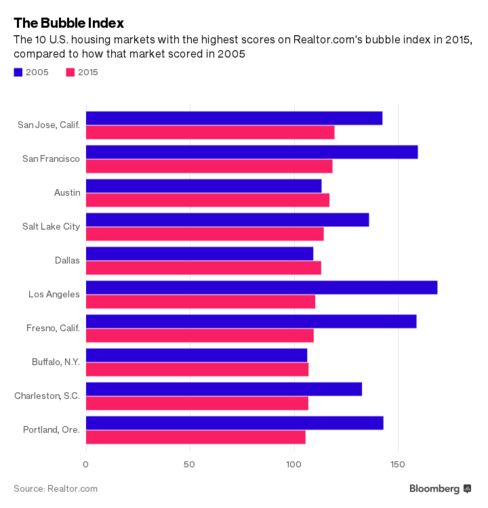
To illustrate his point, Smoke compiled an index based on six factors he deemed crucial to the housing boom and bust of the mid-2000s, including price appreciation, the prevalence of house-flipping, and share of buyers who used mortgage financing. (The other factors are price-to-income, price-to-rent, and housing starts-to-household formation.) Then he benchmarked the index to 2001, a year when the housing market was fairly valued.

Last year, only six metro areas exceeded the benchmark by 10 percent, with San Jose coming in highest, at 19 percent above 2001 levels. In 2005, there were 29 cities that were at least that bubbly, as the chart below shows:

The local markets that look the most like a bubble are, unsurprisingly, places where population is growing faster than housing supply. That includes California cities where zoning regulations have slowed or prevented new construction, as well as Texas markets in which rising land and labor costs, and some lingering aftershocks from the bust, have held back housing starts. Meanwhile, the share of U.S. households that rent is near 50-year highs, helping to drive up rental prices and giving investors across the country incentive to snatch up for-sale homes.  

Prices in Austin and the San Francisco Bay Area, among other places, are probably unsustainable, Smoke said. That could be bad for buyers who get in at the top of the market and bad for the local economy if high housing costs spur talented workers to move away. “We could have a housing cost-induced economic slowdown because people can’t make the housing market work,” Smoke said.


Figuring out how to create enough new housing to meet demand is a tricky question. In one scenario sketched out by Smoke, faster economic growth would lead to higher interest rates, leading banks to lend more easily to homebuyers. In another, a bad economy could slow household growth, dampening demand. Right now, builders are starting new homes at a modest clip despite significant demand, probably because the cost of building them outweigh the prices homes are fetching. “If you were a builder and you could do it, wouldn’t you?” Smoke asked.

The current housing market isn’t without some pockets of speculation, said Daren Blomquist, senior vice president at RealtyTrac. A rule of thumb for investors who flip homes is to buy at a 30 percent discount to the local market, he said. That leaves room to fix up the house and sell at a profit. In the first quarter of 2016, flippers in Denver were buying at a 14 percent discount to market prices, and flippers in Orange County, Calif., were buying at an 11 percent discount.

“They’re riding the wave of rising home prices,” Blomquist said. “They’re not buying low—they’re hoping that they can sell high.”

Facebooktwitterpinterestlinkedin

San Francisco, New York, and San Jose Are the 3 Most Expensive Rental Markets in the U.S. | #ConsiderBuying #TalkToYourRealtor #BuyingMakesSense #ShareInformation

Facebooktwitterpinterestlinkedin

San Francisco, New York, and San Jose Are the 3 Most Expensive Rental Markets in the U.S. – Curbed

    Zumper, an apartment rental startup, has released its latest National Rent Report ranking the median rent of a one-bedroom home in the 100 largest U.S. cities by population, and it comes as no surprise that four of the top 10 highest rents continue to come out of metros in California.

    San Francisco continues to be host to the highest median rent at $3,510 a month, even though the price of one-bedrooms declined in June by about 2.2%. Coming in at number two, New York City’s one-bedrooms also saw a slight dip of 1.8%, with median rent at $3,190 a month.

    The cost of one bedrooms in San Jose, California, which displaced Boston as the third most expensive market last month, is holding steady at $2,280 per month, compared to $2,250 per month at the end of the previous quarter. Rents in Oakland, California are up over the year at about $2,270 a month. Boston’s one-bedrooms continue to see lower rents, now at $2,230 a month, compared to $2,390 at the beginning of the year.

    The rental markets in San Diego, Atlanta, Dallas, Lexington, Kentucky, and Albuquerque, New Mexico, have all seen bumps in the cost of one- and two-bedrooms, while prices have been quieting down in Baltimore, Anchorage, Alaska, San Antonio, Des Moines, Iowa, and El Paso, Texas.

    Zumper analyzes rental data from over 1 million active listings across the United States to create its reports. Have a look at the chart below, and head on over to Zumper for the full picture.

Facebooktwitterpinterestlinkedin

What Are Moms Looking in a House | #GetIdeas #ShareInformation #TalkToYourRealtor #YajneshRai

Facebooktwitterpinterestlinkedin

What Moms Want in a House | Realtor Magazine

The configuration of the home is more important to buyers with children these days, Jeff Martel, a real estate professional with Better Homes and Gardens Real Estate, told MarketWatch.

“Ten years ago, the only thing families were looking for was square footage and a large yard,” he says. But now more family home shoppers are placing an open floor plan high on their list rather than separated rooms.

“Everything happens in the kitchen,” he says. “Kids use the islands now for breakfast, lunch and dinner.”

Here are other house features that parents desire the most, according to real estate professionals:

Office nook: Martel sees a declining interest in having a separate home office. Instead, he has more clients asking for an office nook off the main living space so that parents can better monitor their children while the kids are online. “You want a family office that’s very visible with a direct sightline to the kitchen,” he says.

Garage access: Location of the garage is also important, adds Lindsay Alteri, who works for BHGRE in Raleigh, N.C., and is also a mother of two young children. “If there are stairs to and from the garage, are you going to be willing to go up and down them carrying a child” in from the car? she notes.

Mud room: Also, a garage that walks into an area in the laundry room is desirable, adds Stacy Barry, a real estate professional at Century 21 Scheetz in Indianapolis. “You want a ‘mud room’ that has a bench and some storage for boots that’s done in a hardwood or laminate where you can drop everything like backpacks and jackets,” Martel adds.

Built-in storage: “Kids come with clutter,” Martel says. Parents are wanting a lot of built-in storage in bedrooms, attics, spaces under stairs, and even hidden storage behind bookshelves.

Facebooktwitterpinterestlinkedin

Mortgage Rates Stay Near Record Low | #ShareNews #TalkToYourRealtor #GetInformed #YajneshRai

Facebooktwitterpinterestlinkedin

Mortgage Rates Stay Near Record Low | Realtor Magazine

Mortgage rates barely budged this week, staying near record lows. The 30-year fixed-rate mortgage averaged 3.42 percent this week, just slightly above its all-time record low of 3.31 percent set in November of 2012.

“We describe the last few weeks as A Tale of Two Rates,” says Sean Becketti, Freddie Mac’s chief economist. “Immediately following the Brexit vote, U.S. Treasury yields plummeted to all-time lows. This week, markets stabilized and the 10-year Treasury yield rebounded sharply. In contrast, the 30-year mortgage rate declined after the Brexit vote, but only by half as much as the 10-year Treasury yield. This pattern suggests that mortgage rates are likely to remain low throughout the summer.”

Freddie Mac reports the following national averages with mortgage rates for the week ending July 14:

  • 30-year fixed-rate mortgages: averaged 3.42 percent, with an average 0.5 point, rising slightly from last week’s 3.41 percent. A year ago, 30-year rates averaged 4.09 percent.
  • 15-year fixed-rate mortgages: averaged 2.72 percent, with an average 0.5 point, dropping from last week’s 2.74 percent. A year ago, 15-year rates averaged 3.25 percent.
  • 5-year hybrid adjustable-rate mortgages: averaged 2.76 percent, with an average 0.4 point, rising from last week’s 2.68 percent average. Last year at this time, 5-year ARMs averaged 2.96 percent
Facebooktwitterpinterestlinkedin