5 Kitchen Mistakes That Could Sink a Sale | #KitchenIdeas #TalkToYourAgent #SiliconValleyAgent #YajneshRai #01924991 #YourAgentMatters #TeamYaj #SangeetaRai #02026129

Facebooktwitterpinterestlinkedin

5 Kitchen Mistakes That Could Sink a Sale | Realtor Magazine

Buyers put a lot of their focus on the kitchen. After all, it can be one of the most expensive rooms to remodel and its features and conditions can make or break a sale.

Designers recently shared a list of the items with realtor.com® that could be subtly sabotaging a kitchen’s attractiveness, including:

Fluorescent lighting

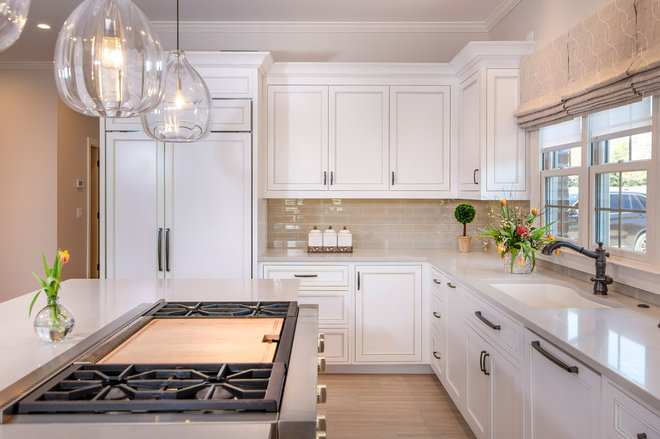
“Nothing screams ‘cheap kitchen’ more than outdated fluorescent tube lighting with a yellowing plastic cover,” Jamie Novak, author of “Keep This Toss That,” told realtor.com®. Swapping out bad lighting for a budget-friendly chandelier or pendant lights can make a big difference, designers say. Or, try a small table lamp on the kitchen counter to soften the light, and remove any curtain valances from the window to allow more natural light in, suggests Karen Gray-Plaisted of Design Solutions KGP.

Overcrowded counters

Clutter is the enemy when you go to sell a home, and that means piles of old mail or several small appliances sitting on top of countertops. “Keeping anything up there, like teapots or dried flowers, is a dated way to decorate a kitchen,” Katie McCann, a professional organizer and owner of Haven, a home and office organizing company in New York, told realtor.com®. Remove rows of planters, baskets that line the top of kitchen cabinets, and any knickknacks on the countertop, designers say.

Dated drawer knobs

Drawer knobs or pulls that are chipped or scratched can make a kitchen look unkempt. However, this can be an inexpensive DIY project that provides an instant update. “Think of them as jewelry for the space,” Drew Henry of Design Dudes told realtor.com®.

Faux plants

Fake plants can cheapen a kitchen’s look, too. Remove the artificial potted ivy at the top of the refrigerator or row of faux greenery at the top of the kitchen cabinets. Instead, have a vase of fresh flowers on the kitchen island, or place a few potted herbs along the kitchen windowsill for a real touch of greenery, Novak suggests.

Unsightly trash cans

Plastic anything needs to be removed, designers say—especially that free-standing plastic trash can on the floor. If it needs to be left out, swap it out for a trash can made of metal. It’ll offer a more polished look to the kitchen. Better yet, “go for a model that will fit in a closet or pantry, or install a cabinet unit that offers the slide-out trash can feature,” Henry suggests.

Facebooktwitterpinterestlinkedin

Housing Could Turn Around Weakening Economy | #InvestInRealEstate #TalkToYourAgent #SiliconValleyAgent #YajneshRai #01924991 #YourAgentMatters #TeamYaj #SangeetaRai #02026129

Facebooktwitterpinterestlinkedin

Housing Could Turn Around Weakening Economy | Realtor Magazine

The longest economic expansion in the nation’s history—now approaching 10 years—may be nearing an end, writes Lawrence Yun, chief economist of the National Association of REALTORS®, in his latest column at Forbes.com. But the housing market could help turn around some sluggish economic numbers, such as business and consumer spending.

Consumer spending is slowing, despite a record number of jobs, rising wages, and plentiful wealth accumulation by homeowners and stock market investors, Yun notes. Rising tariff fights are also causing some recent hesitancy within the economy, Yun notes. He says that slower activity on international exports and imports have correlated with a slowing economy in the past.

“Real estate is the key area for future growth and a savior in the continuing economic expansion,” writes Yun. But while demand remains high, “there is a housing shortage, and hence a critical need to build more homes, especially at moderately priced points where the demand is strongest.”

Yun says that rising home sales and increased housing starts have long been associated with economic expansion. “More home sales also mean increased numbers of Americans who can participate in wealth gains,” he notes. “Consequently, consumer spending, including vehicle sales, can then turn higher.”

Still, while overall economic expansion may be slowing, Yun brushes off recession fears. He believes the economy will continue to expand from the housing market. “If the housing market turns measurably higher, the economy looks to do just fine for the remainder of the year and even better next year,” he notes. “If the trade war rhetoric quiets down and a genuine trade agreement is signed allowing for even more business freedom, then expect an economic boom.”

Facebooktwitterpinterestlinkedin

Mortgage Rates Inch Up, But Buyers Are Still Getting Deals | #MortgageInchesUp #TalkToYourAgent #SiliconValleyAgent #YajneshRai #01924991 #YourAgentMatters #TeamYaj #SangeetaRai #02026129

Facebooktwitterpinterestlinkedin

Mortgage Rates Inch Up, But Buyers Are Still Getting Deals | Realtor Magazine

Mortgage rates for 30, 15, ARM. Full information at http://www.freddiemac.com/pmms/

© REALTOR® MAGAZINE


After three weeks of mostly staying steady, average mortgage rates rose this week. However, rates still remain at multiyear lows, keeping borrowing costs low for those shopping for homes this summer.

“The rise in rates was driven by continued improvement in consumer spending and partly due to optimism around a forthcoming cut in short-term interest rates, which should provide support for business and investor sentiment,” says Sam Khater, Freddie Mac’s chief economist. “Despite this slight increase in rates, home buyers are taking advantage of the multiyear low rates in droves, which is evident in the consistently higher refinance and purchase application volumes. The improvement in housing demand should provide sufficient momentum for the housing market and economy during the rest of the year.”

Freddie Mac reported the following national averages with mortgage rates for the week ending July 18:

  • 30-year fixed-rate mortgages: averaged 3.81%, with an average 0.6 point, up from last week’s 3.75%. Last year at this time, 30-year rates averaged 4.52%.
  • 15-year fixed-rate mortgages: averaged 3.23%, with an average 0.5 point, rising from last week’s 3.22% average. A year ago, 15-year rates averaged 4%.
  • 5-year hybrid adjustable-rate mortgages: averaged 3.48%, with an average 0.4 point, rising from last week’s 3.46% average. A year ago, 5-year ARMs averaged 3.87%.
Facebooktwitterpinterestlinkedin

Build More Homes or Else … Get Fined? | #TooManyNewHomes? #NotReally #TalkToYourAgent #SiliconValleyAgent #YajneshRai #01924991 #YourAgentMatters #TeamYaj #SangeetaRai #02026129

Facebooktwitterpinterestlinkedin

Build More Homes or Else … Get Fined? | Realtor Magazine

In a move to address the housing shortage, some California cities may start to face some stiff penalties if they don’t start building more homes. Under a new bill, California cities could face fines up to $600,000 per month if they don’t build more homes for their residents.

A court can find a city or county in violation of state laws that set targets for how much housing a community needs to build to meet its population needs.

If found in violation, local governments would have a year to comply before the fine kicks in. Following six months of fines, the court could even take over a local government’s authority over its housing plans, according to the bill.

California has increasingly become the epicenter for the national housing shortage. California Gov. Gavin Newsom and state lawmakers have pledged to create a $1 billion fund to reward communities for “pro-housing” local laws that are aimed at ramping up construction.

“If cities aren’t interested in doing their part, if they’re going to thumb their nose at the state and not fulfill their obligations under the law, they need to be held accountable,” Newsom said at a recent news conference.

In January, California lawmakers sued Huntington Beach and accused Orange County of not doing enough to add housing for low-income residents. Newsom has threatened to sue other cities.

However, some officials are concerned about California’s latest movement in punishing cities that fall short of meeting housing goals. “We find new penalties on local governments already struggling to add housing and address homelessness concerning,” Graham Knaus, executive director of the California State Association of Counties, said in a statement. “Nonetheless, California’s 58 counties stand ready and committed to meet this challenge.”

Facebooktwitterpinterestlinkedin

Owners Spend More to Spruce Up Newer Homes Than Older Homes | #Upgrades #TalkToYourAgent #SiliconValleyAgent #YajneshRai #01924991 #YourAgentMatters #TeamYaj #SangeetaRai #02026129

Facebooktwitterpinterestlinkedin

Owners Spend More to Spruce Up Newer Homes Than Older Homes | Realtor Magazine

Homeowners are spending more to improve their homes, not necessarily on home maintenance.

Homes may be aging in the U.S., but don’t assume the age of a home is prompting more spending. A new report from HomeAdvisor, a home remodeling resource, finds that homeowners spent $3.70 less for every year since a home was built. That means the owner of a 100-year-old home could spend an average of $370 less on emergency home projects per year than the owner of a new home, the study notes.

Researchers say the growing cultural focus on design aesthetics and quality of life as well as newer and better home improvement tools may be leading to the uptick in home improvement spending.

Room remodels have been the most popular home improvement projects, with bathrooms topping HomeAdvisor’s list. Homeowners also are prioritizing new appliances, roof replacements, and hardwood refinishing.

Overall, owners spent an average of $9,081 on home improvement, maintenance, and emergencies for 2018, according to the report. Spending per household on home services is up 17% in 2018 from 2017, according to HomeAdvisor’s newly released report, the “State of Home Spending Report,” which focuses on home service spending.

Motivations for home improvements can differ depending on age group. For example, millennials were more likely than other generations to say they completed home projects to increase their home’s value. Baby boomers and Generation X, on the other hand, tended to be more motivated to “modernize” their homes. Millennials and the silent generation also were motivated to “improve aesthetics and design.”

“It makes sense that first time home buyers complete more home improvement projects and spend more money on home services,” says Mischa Fisher, HomeAdvisor’s chief economist and author of the report. “Many of the millennials who bought a home in the last few years are seeking upgrades to increase the value of their homes and improve aesthetics. This focus on return on investment from millennials is likely due to a combination of typical youthful focus on wealth accumulation and their comparatively poorer financial situation driving a hunger to recover relative to their older cohorts.”

Homeowners are spending more on home improvement projects than home maintenance projects, the report showed. For every $1 spent on home maintenance, homeowners spent an average of $5 on home improvement projects.

Homeowners should put aside money for house emergencies, financial experts say. One in three homeowners say they’ve completed an emergency home project, with the average cost about $1,206, over the past year, according to the study. Owners who live in areas prone to extreme weather events reported the highest spending from housing emergencies.

Facebooktwitterpinterestlinkedin

5 Remodels That Make Good Resale Value Sense — and 5 That Don’t | #Remodeling #TalkToYourAgent #SiliconValleyAgent #YajneshRai #01924991 #YourAgentMatters #TeamYaj #SangeetaRai #02026129

Facebooktwitterpinterestlinkedin

5 Remodels That Make Good Resale Value Sense — and 5 That Don’t

Repeat after me: I am the master of my remodel. Perhaps you should say it again, because sadly, it’s not always so. Remodels sometimes have a tendency to develop their own inertia, as decisions lead to new dilemmas, unintended consequences and surprising outcomes. In some cases, these flights of fancy are perfectly acceptable, provided the design and completed execution truly align with the vision and budget.

But if your budget is a concern, and the wise investment of limited home improvement dollars matters, then there are a few basic guidelines you should familiarize yourself with before planning your remodel. Today we review five remodels that typically make good financial sense, providing a nice return on the investment at the time of resale — and five that don’t.
Facebooktwitterpinterestlinkedin

Buyers Aren’t Shying Away From Supersized Mortgages | #Mortgages

Facebooktwitterpinterestlinkedin

Buyers Aren’t Shying Away From Supersized Mortgages | Realtor Magazine

Borrowers found it easier to access credit in June, but it was jumbo mortgage credit that saw some of the highest growth. According to a new report from the Mortgage Bankers Association, jumbo loans—mortgages with higher debt—are on the rise and were easier to get in June than any other month in the past eight years.

Jumbo mortgage credit rose for the sixth straight month, rising to its highest level since 2011, when the MBA’s survey began.

A jumbo loan is a type of financing designed to finance luxury properties and homes that exceeds the limits set by the Federal Housing Finance Agency. The valuesvary by state. As of 2019, the limit for a jumbo mortgage was set at $484,350 for most of the country, and up to $726,525 in counties with higher home values.

Mortgage rates for jumbo loans have remained low, which may be adding to their appeal. The average contract interest rate for 30-year, fixed-rate mortgages with jumbo loan balances—those greater than $484,350—increased to 4.03% from 4% last week, the MBA reported Wednesday.

“Credit availability has generally increased in 2019 as lenders have worked to meet affordability challenges,” says Joel Kan, the MBA’s associate vice president of economic and industry forecasting. “Because mortgage rates have recently fallen and home price growth has decelerated in many markets, credit availability may stabilize at its current levels.”

Facebooktwitterpinterestlinkedin

Investment Property: How Much Can You Write Off on Your Taxes? | #RentalProperty #TalkToYourAgent #SiliconValleyAgent #YajneshRai #01924991 #YourAgentMatters #TeamYaj #SangeetaRai #02026129

Facebooktwitterpinterestlinkedin

Investment Property: How Much Can You Write Off on Your Taxes?

Learn how to navigate the tricky tax laws around investment properties, including ways to save.

There are certain things you can do as a real estate investor to help manage your tax bill and maximize your after-tax return on investment. To do so, however, you need to understand the primary ways in which investment real estate portfolios get taxed. You must also have a general grasp of some abstract concepts like calculating your tax basis, as well as the depreciation of capital investments.

Warning: This article is not going to make you an expert. But it will acquaint you with the basic terminology so you can be better prepared for a meeting with your tax adviser.

Taxation of rental income

The IRS taxes the real estate portfolios of living investors in two primary ways: income tax and capital gains tax. (A third way, estate tax, applies only to dead investors.)

Rental income is taxable — as ordinary income tax. That means you must declare it as income on your tax return and pay income tax on it. Unlike wages, rental income is not subject to FICA taxes.

Your income is everything you get from rents and royalties on the property, minus any deductible expenses. You can’t deduct everything though. You can only deduct mortgage interest and repairs you make that restore the property to its original minimally functional condition. You can’t deduct capital investments like new buildings, additions or renovations. More on these later.

Capital gains tax

The second tax bill you need to worry about is capital gains tax. The IRS taxes you on any net profits you get out of a property when you sell it. If you’re flipping the property and you’ve owned it for less than a year, you pay short-term capital gains tax, which is the same rate as your marginal income tax rate. If you’re in the 28% tax bracket, you’ll pay a 28% tax on short-term capital gains.

If you hold the property for 12 months, you’ll qualify for more favorable long-term capital gains. Depending on your marginal income tax bracket, these taxes could range from 0% to 15%. In every bracket, however, the IRS takes a smaller cut out of long-term gains than out of ordinary income or short-term gains.

Calculating capital gains

You pay capital gains tax on the difference between your selling price in the property and your adjusted tax basis. Your adjusted tax basis in a property is the original cost you paid for the property, plus any amount invested in renovations and improvements (including labor costs on these projects) that you have not previously deducted for taxes.

If you have deductions associated with the property, you subtract them from your tax basis. If your adjusted tax basis is higher than your sale, you have a capital loss. You can subtract capital losses from a given year from capital gains to reduce your tax bill. If you have more capital losses than capital gains, you can “carry forward” these capital losses into future years to offset future capital gains. If you have no capital gains, you can deduct $3,000 annually until you have recognized all your capital loss carryforward.

How to defer capital gains taxes: an intro to like-kind exchanges

The IRS provides an important exception to capital gains taxation, made-to-order for real estate investors: If you own an investment property, you can sell your property at a profit and roll your money over into another property within 60 days without having to pay capital gains taxes at all. This transaction is known as a Section 1031 exchange, named for the section of the U.S. Revenue Code that allows it. You cannot swap your rental property for a personal residence, or vice versa. For this reason, these exchanges are called like-kind exchanges, in that the property you replace it with needs to be substantially similar to what you sold.

The 1031 exchange makes it possible for real estate investors to defer paying capital gains tax, which is another advantage over investing in mutual funds, stocks, bonds and other securities or collectibles. Outside of a retirement account, you have to pay tax on gains in these items by April 15 of the year after you sold them.

Depreciation and amortization

This is a broad concept, so we can only cover the very basics here. When you buy investment property — be it a building, a computer or a horse — the IRS knows that the item won’t stay young and new forever. Over time, the property will decrease in value. Depreciation is the process of claiming a deduction to compensate you for the property’s decrease in value during the year.

Note: You can’t depreciate your personal residence. You can only depreciate investment property. For more information on the process of depreciation, see IRS Publication 946, How To Depreciate Property.

Land, of course, doesn’t depreciate. But minerals underneath the land do. If you are extracting oil or other minerals, or timber, for that matter, from the land, you will account for the gradual loss in value through a process called depletion.

Likewise, when you make a purchase of investment real estate or capital equipment with a useful life of longer than a year, the IRS knows you will be using that property to generate income for a long time to come.

Except in certain circumstances, the IRS does not allow you to deduct the full cost of your investment in the first year. Instead, you must amortize your investment over a number of years. For real estate, you must spread the deduction out over 27.5 years.

Passive activity rules

Again, these rules are complex. But in a nutshell, if you are a passive investor — meaning you are not working day to day in the business of managing your real estate investments — you are subject to passive activity rules. Basically, you can only deduct passive losses to the extent that you can cancel out gains from passive activities. These rules restrict your ability to use passive activity losses to offset capital gains elsewhere in your portfolio. Congress implemented these rules in 1986 to eliminate tax loopholes and abusive tax shelters.

Most individual investor landlords can deduct up to $25,000 per year in losses on rental properties, if necessary (subject to income limitation). Hopefully you won’t have to make use of this provision much.

Property taxes

Expect to pay property taxes to local and county governments each year. Your local government will assess the market value of your property at its “highest and best use” and charge you a percentage of that value every year. You can deduct property taxes against your rental income, though, provided the property tax is uniformly assessed throughout the jurisdiction and is not a special assessment.

Other tax deductions

Watch for opportunities to take deductions for these common real estate investment expenses:

  • Mortgage interest
  • Legal fees related to your investment properties or business
  • Mileage
  • Business use of your home (the home office deduction)
  • Advertising fees

Employees (but if they are working on capital improvements or renovations, you have to amortize their labor costs as part of your capital investment, rather than as a current year expense.)

Facebooktwitterpinterestlinkedin

Carve Out the Perfect Outdoor Space: 3 Tips | #BackYardTips #TalkToYourAgent #SiliconValleyAgent #YajneshRai #01924991 #YourAgentMatters #TeamYaj #SangeetaRai #02026129

Facebooktwitterpinterestlinkedin

Carve Out the Perfect Outdoor Space: 3 Tips | Realtor Magazine

The backyard can be a selling point in your listing, no matter the size. Up your listing’s backyard appeal by transforming it into an entertaining space. Houselogic, a home remodeling and design website, offers some key areas to address to achieve the look:

1. Create privacy.

Make the backyard a private sanctuary for homeowners. Precast concrete geometric blocks, for example, can protect privacy without blocking light, Houselogic suggests. They can be used as a vertical element to make smaller yards feel bigger.

2. Mimic the indoors.

Make the spaces functional by taking a cue from the indoors. Sellers may get much of their money back too: Homeowners tend to recoup 70% of their costs on resale after building a new patio and an outdoor kitchen gets 71%, according to the National Association of REALTORS®’ “Remodeling Impact Report.” Consider adding built-in benches for seating or hanging a chandelier or pendant lights for functional lighting over the dining space, Houselogic recommends.

3. Add some shade.

Extending the roof may be a pricey option, but there are other ways to make the backyard more shielded and inviting from that summer sun. Houselogic recommends a pergola planted with vines or a retractable awning.

Facebooktwitterpinterestlinkedin

Mortgage Rates Barely Budge From 3-Year Lows | #GreatNews #TalkToYourAgent #SiliconValleyAgent #YajneshRai #01924991 #YourAgentMatters #TeamYaj #SangeetaRai #02026129

Facebooktwitterpinterestlinkedin

Mortgage Rates Barely Budge From 3-Year Lows | Realtor Magazine

Mortgage rates for 30, 15, ARM. Full information at http://www.freddiemac.com/pmms/

© REALTOR® MAGAZINE


After steady declines since the beginning of the year, mortgage rates appear to be leveling off. But that still bodes well for home buyers.

“While rates have moderated, we’re still at nearly three-year lows, which is good news for buyers looking to purchase a home before school starts,” says Sam Khater, Freddie Mac’s chief economist. “The recent stabilization mortgage rates reflects modestly improving U.S. economic data and a more accommodative tone from the Federal Reserve to respond to the rising downside economic risk from trade tensions and soft global economic data. On the housing front, the latest weekly purchase application data suggests home buyer demand continues to rise, which is consistent with the slowly improving real estate data from the last two months.”

Freddie Mac reports the following national averages with mortgage rates for the week ending July 11:

  • 30-year fixed-rate mortgages: averaged 3.75%, with an average 0.5 point, unchanged from last week. Last year at this time, 30-year rates averaged 4.53%.
  • 15-year fixed-rate mortgages: averaged 3.22%, with an average 0.5 point, rising from last week’s 3.18% average. A year ago, 15-year rates averaged 4.02%.
  • 5-year hybrid adjustable-rate mortgages: averaged 3.46%, with an average 0.4 point, rising from last week’s 3.45% average. A year ago, 5-year ARMs averaged 3.86%.
Facebooktwitterpinterestlinkedin