Contract signings rose in all four major regions across the U.S. last month, a sign that dwindling home sales—which have plagued the market at an unusual time of year this summer—will reverse course in the coming months, the National Association of REALTORS® reports.
NAR’s Pending Home Sales Index, a forward-looking indicator based on contract signings, increased 0.9 percent month over month in June to a reading of 106.9. “After two straight months of declines in pending home sales, home shoppers in a majority of markets had a little more success finding a home to buy last month,” says NAR Chief Economist Lawrence Yun. “The positive forces of faster economic growth and steady hiring are being met by the negative forces of higher home prices and mortgage rates. Even with slightly more homeowners putting their home on the market, inventory is still subpar and not meeting demand. As a result, affordability constraints are pricing out some would-be buyers and keeping overall sales activity below last year’s pace.”
Despite last month’s rise, contract signings are still down 2.5 percent compared to a year ago, NAR reports. Nevertheless, Yun says the worst of the supply crunch may now have passed. In June, existing inventory was up slightly on an annual basis, marking the first increase in three years. Several large metros saw year-over-year surges in inventory levels last month:
Portland, Ore.: +24 percent
Providence, R.I.: +20 percent
Seattle: +19 percent
Nashville, Tenn.: +17 percent
San Jose, Calif.: +15 percent
“Home price growth remains swift, and listings are still going under contract at a robust pace in most of the country, which indicates that even with rising inventory in many markets, demand still significantly outpaces what’s available for sale,” Yun says. “However, if this trend of increasing supply continues in the months ahead, prospective buyers will hopefully begin to see more choices and softer price growth.”
The U.S. homeownership rate posted another increase, reaching 64.3 percent in the second quarter, up a tenth of a percentage point from the first quarter, the Commerce Department reported this week. The rate has increased 0.6 percentage points over the past year.
Younger Americans, specifically those under the age of 35, are behind most of the recent increases in the ownership rate. The homeownership rate of this younger buyer group increased to 36.5 percent in the second quarter, up 1.2 percentage points from a year earlier.
Despite the overall increase in the second quarter, the homeownership rate still remains far below its peak of 69.2 percent in late 2004.
Some economists are skeptical whether the homeownership rate will continue its recent climb. Sales of existing homes dropped 2.2 percent in June, and sales of newly built homes also dropped in June compared to the previous month, according to the National Association of REALTORS® and National Association of Home Builders. Low inventories of homes for-sale, higher home prices, and higher mortgage rates are all keeping an unseasonal lid on home sales this summer. Existing-home prices have surged 5.2 percent over the past year to a record high in June, NAR reports. The 30-year mortgage rate has increased more than half a percentage point since early January to 4.54 percent, according to Freddie Mac.
“Homeownership has bottomed out, but is likely to go more or less sideways for the foreseeable future,” Mark Zandi, economist of Moody’s Analytics, told The Wall Street Journal. “Easing credit standards and a strong job market will support homeownership, but higher mortgage rates and the change in the tax law weigh on it.”
Mortgage rates reversed course this week, rising slightly over the past week and reaching their highest level since late June, Freddie Mac reports.
“The next few months will be key for gauging the health of the housing market,” says Sam Khater, Freddie Mac’s chief economist. “Existing sales appear to have peaked, sales of newly built homes are slowing and unsold inventory is rising for the first time in three years.”
Affordability pressures are mounting in many markets, with the combination of continuous price gains and higher mortgage rates, Khater says. These factors “appear to be giving more prospective buyers a pause,” he says. “This is why new and existing-home sales are not breaking out this summer despite the healthy economy and labor market.”
Freddie Mac reports the following national averages with mortgage rates for the week ending July 26:
30-year fixed-rate mortgages: averaged 4.54 percent, with an average 0.5 point, rising from last week’s 4.52 percent average. Last year at this time, 30-year rates averaged 3.92 percent.
15-year fixed-rate mortgages: averaged 4.02 percent, with an average 0.4 point, increasing from last week’s 4 percent average. A year ago, 15-year rates averaged 3.20 percent.
5-year hybrid adjustable-rate mortgages: averaged 3.87 percent, with an average 0.4 point, and were unchanged from last week. A year ago, 5-year ARMs averaged 3.18 percent.
Consumers who make efforts to raise their credit scores from “fair” to “very good” may see big payoffs. LendingTree researchers analyzed loan request and average loan balance data to see how a lower credit score can increase borrowing costs for the average consumer. They compared the impact across several types of debt: mortgages, student loans, auto loans, personal loans, and credit cards.
Overall, raising a credit score from “fair” (580-669) to “very good” (740-799) can save a consumer $45,283 on their debt. That’s the average in extra interest on all debt that consumers will pay when they have a credit score ranked as fair. Mortgage costs can account for 63 percent of those potential savings. By raising a credit score from fair to very good, consumers could save $29,106 in mortgage costs, the study shows.
For example, a person with a high credit score would likely have a monthly mortgage payment that is $81 less than someone with a fair credit score. “The person with very good credit could invest that money, use it to pay down debts faster, or to increase the down payment on future loans, which could exponentially increase the value of those savings over the same 30-year period,” LendingTree reports.
The home’s garage, large backyard, and updated kitchen may not be as important to home shoppers as the school district, according to a new survey released by realtor.com® of more than 1,000 people who closed on a home in 2018. Seventy-eight percent of buyers surveyed say they’re willing to give up home features to get their school district of choice, and home shoppers are willing to give up their most desired home features to get that.
“Most buyers understand that they may not be able to find a home that covers every single item on their wish list,” says Danielle Hale, chief economist for realtor.com®. “But our survey shows that school districts are an area where many buyers aren’t willing to compromise. For many buyers, ‘location, location, location,’ means ‘schools, schools, schools.’”
The extent of compromises that buyers are willing to make to get their top-choice schools may be surprising too. For example, 78 percent of buyers who said schools were important in their house hunt said they had to compromise on certain home features. The features they most commonly reported giving up in exchange for their preferred school district were a garage (19 percent); a large backyard (18 percent); an updated kitchen (17 percent); desired number of bedrooms (17 percent); and an outdoor living area (16 percent). A spring home buyer survey conducted by realtor.com® had showed a garage was the number one feature that home buyers were looking for this year, followed by an updated kitchen and an open floor plan.
Not surprising, the desire for particular schools did vary by a buyer’s life stage and age. Ninety-one percent of buyers with children said school boundaries are important or very important compared to 34 percent of those without children.
Buyers surveyed said they determined the school district they wanted to live in by looking at schools’ test scores, followed by the availability of accelerated programs, arts and music, diversity, and before- and after-school programs. Realtor.com® offers a tool through its site’s search to specify a district or school boundary so buyers can search for homes within that preferred area.
Sellers are cashing in on yet another record high for sale prices, with the median annual return on home sales reaching 8 percent nationally over the last 12 months, according to realtor.com®. But some cities are seeing annual returns stretch as high as 14 percent, researchers found in an analysis of the 100 largest U.S. metros. “Owning can be a great way to build up overall net worth,” says realtor.com® Chief Economist Danielle Hale. “If you’re looking to transition in a local market [to a bigger home], you have the home equity. If you’re looking to retire and move somewhere else, you have the money to do that.”
Some of the nation’s fastest-growing cities are seeing the highest returns, as well as areas that were hardest hit during the Great Recession. Some homeowners “walked into the room when everyone was running out,” says Jonathan Miller, president and CEO of appraisal firm Miller Samuel in New York. “They are now being compensated for their risk.”
In its analysis, realtor.com® defined profit as the difference between the two most recent sales of a property and used that information to create an average annualized return for its rankings. (The site limited its rankings to one metro per state for geographic diversity.) The cities that ranked highest on realtor.com®’s list as the most profitable housing markets for sellers are:
Nearly three in 10 mortgage borrowers either don’t know the rate they’re paying on their loan or decline to disclose it, according to a new survey by Bankrate. Consumers who don’t keep track of their mortgage rate may be making an expensive mistake, financial experts caution. “Most homeowners should know what their rate is,” says Martin Choy, operations manager at Westwood Mortgage in Seattle. “If they have an adjustable-rate mortgage, then they should contact their lender immediately and get their current rate.”
As mortgage rates inch higher, lenders are urging homeowners to check their rate and see if refinancing makes sense. As of July 11, the 30-year fixed-rate mortgage had increased to 4.7 percent from 4.13 percent a year ago, Bankrate reports.
The increase can have a big impact on monthly mortgage payments. For example, a $200,000 mortgage with a 4.7 percent interest rate can cost $119 more per month than the same mortgage with a 4.13 percent rate. Homeowners with adjustable-rate mortgages or fixed-rate mortgages may be able to lock in a lower rate if they’ve held the loan for a long time, financial experts say. “There are many variables in determining whether refinancing is a good option,” Choy says. “How much do you owe? How much is your house appraised for? Is your credit score good? If you’re in better financial shape now—both with your monthly debt ratio and credit score—than when you got your mortgage, then you could qualify for better rates.”
The cost to refinance can vary, but, on average, borrowers can expect to pay between 3 and 6 percent of their balance in refinancing fees, according to Bankrate.
Built-in shelves can take your room from boring to bespoke in a snap. Unfortunately, they can also come with a hefty price tag.
But I’m going to share the insider secrets you need to DIY your way to rich results without breaking the bank. (Hint: The secret is starting with assembled bookcases, like the IKEA BILLY!)
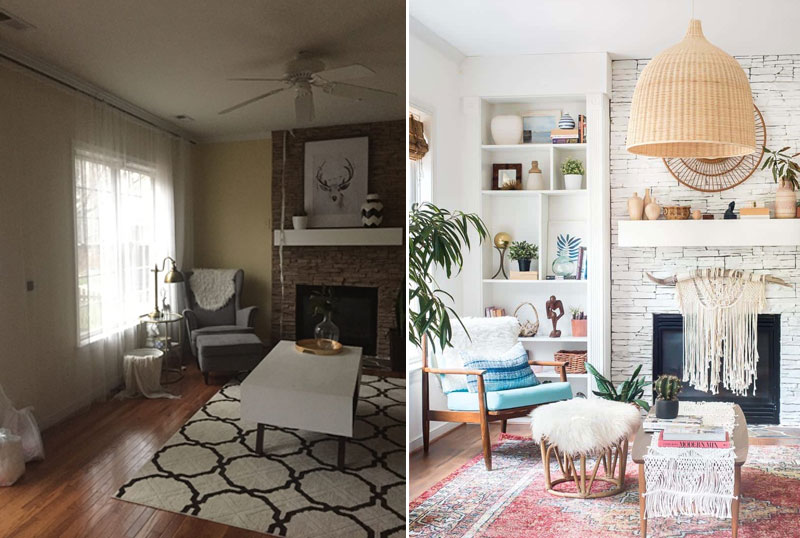
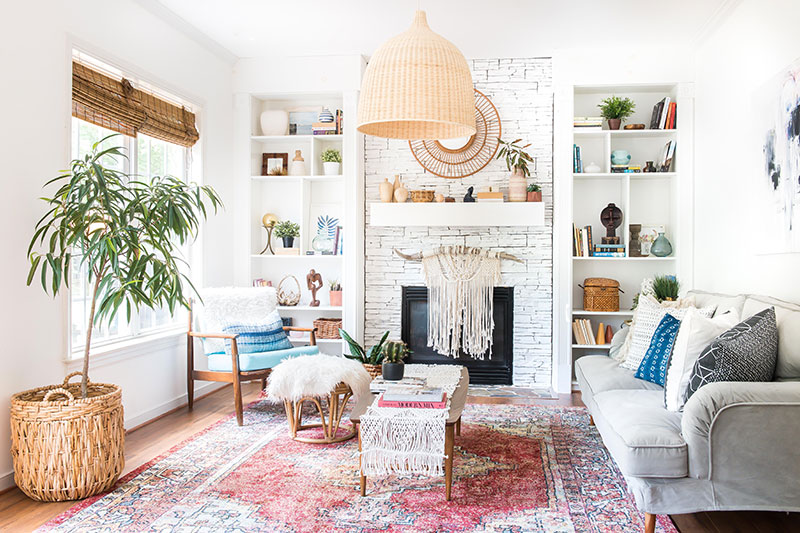
Check out this dramatic before and after:
I still walk in sometimes and can’t even believe it’s the same room. Of course, there have been many other updates and projects to get this look, but the shelves definitely set the stage.
Let’s get started!
Materials
Note: Always measure first to get your supplies right. Our measurements were not exactly equal, with a width of 41″ on one side of the fireplace and 43″ on the other. But we compensated with our build-out around it, and it made no difference at all.
Two 1″ x 12″ x 10′ whitewood boards (for visible sides next to fireplace)
Two 1″ x 4″ x 12″ common boards (Each cut to length, then screwed into the wall studs flush behind each shelf for support. This compensates for the 1″ difference in the whitewood boards and BILLY bookcase depth)
3″ drywall screws to attach common board to studs
Three 2″ x 4″ x 10′ boards (for hidden sides next to walls and for header frame)
Eight 2″ x 4″ x 11″ pieces (to fill gaps between shelf and whiteboard on fireplace side)
Four 4 1/4″ x 1 1/8″ x 9″ plinth blocks of choice
Four 4 1/4″ x 1 1/8″ x 4 1/4″ plinth blocks of choice
Four 15/32″ x 3 9/16″ x 96″ strips of millwork molding (to cover the left and right edges of each shelf)
Eight 1 1/2″ x 2″ x 1 3/8″ 18-gauge steel brackets and nails
Brad nails (or finish nails)
Tools
Miter saw or skill saw
Brad nailer (recommended)
Drill kit
Tape measure
Let’s build!
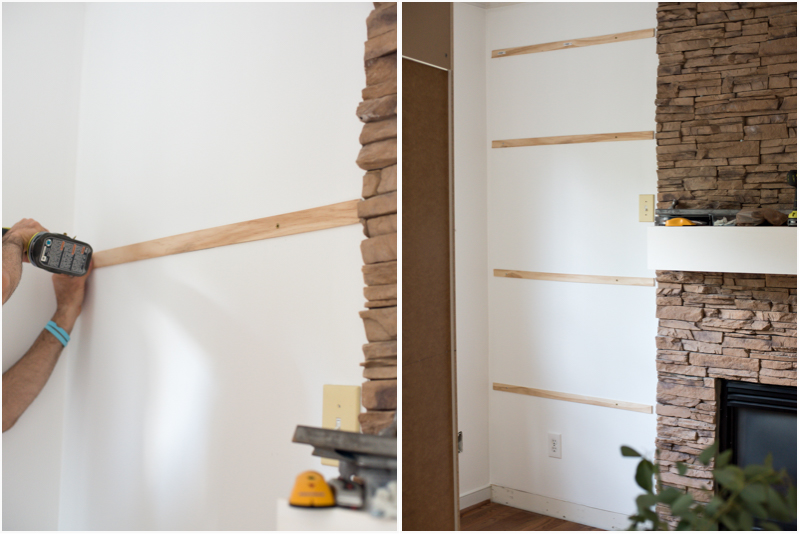
Mark your studs, and screw the cut 1″ x 4″ common board to the wall and into the studs with the drywall screws, spaced every 6-12″. Space the strips a few feet apart from top to bottom to get the best support.
Cut out the crown molding, shoe molding and baseboard if needed.
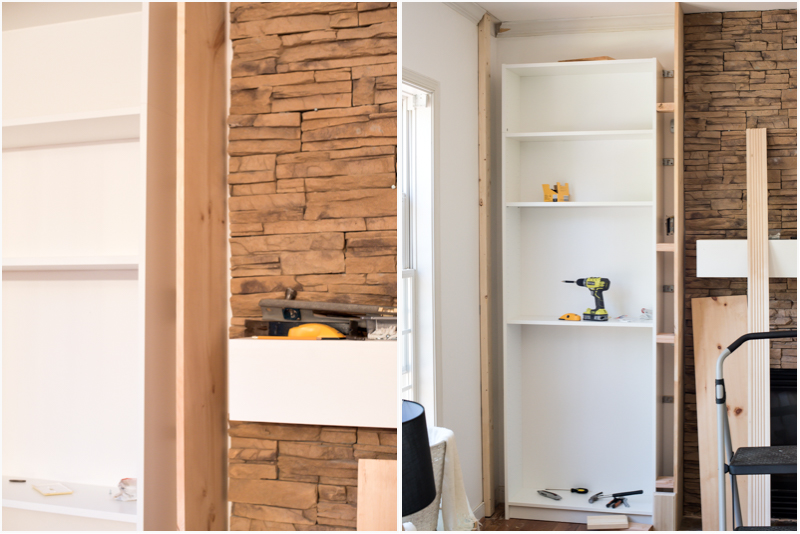
Press the bookcases flush to the strips on the walls, center them and attach the steel brackets to the bookcases and the strips screwed to the walls.
Measure (ceiling to floor) the wall side where you want the outer edge of your shelf.
Cut the 2″ x 4″ to length and attach to the wall.
Measure (ceiling to floor) the fireplace side where you want the edge of your shelf.
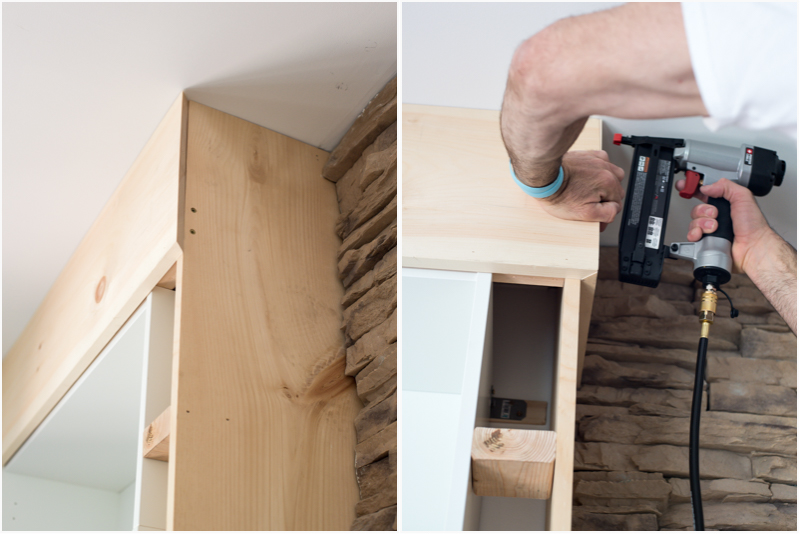
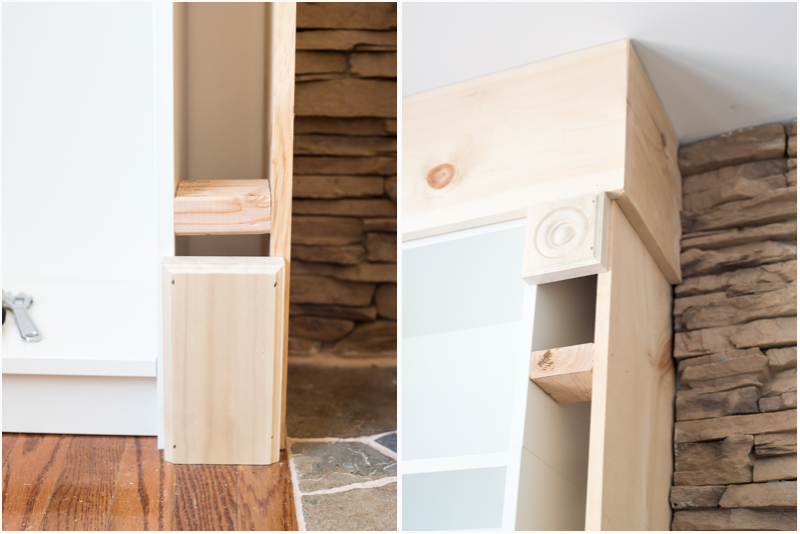
Cut the 1″ x 12″ whiteboard to length and attach using 2″ x 4″ blocks to hold the gap.
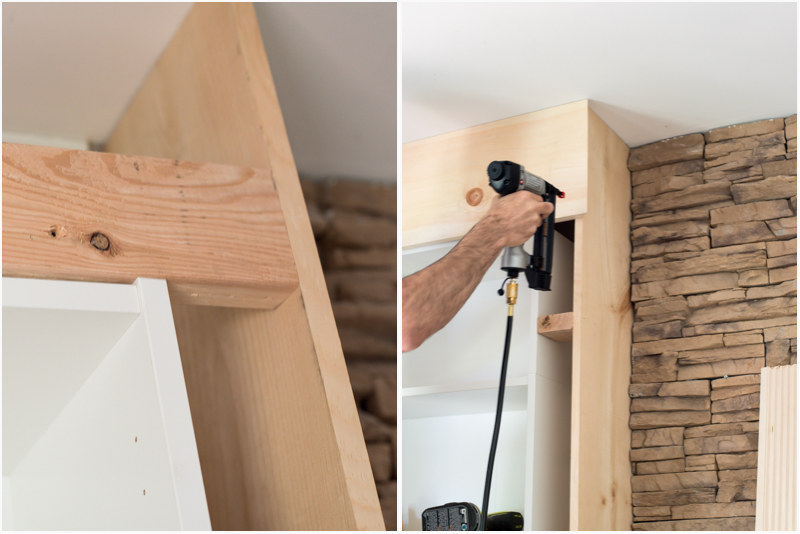
Measure from the inside of the 2″ x 4″ to the inside of the 1″ x 12″ across the top of the bookcase. Cut another 2″ x 4″ to fit the space, and screw it in on each side.
Measure and cut the 1″ x 12″ whiteboard designated for the top. Brad nail across the front first and then the side.
Now place and brad nail the plinth blocks.
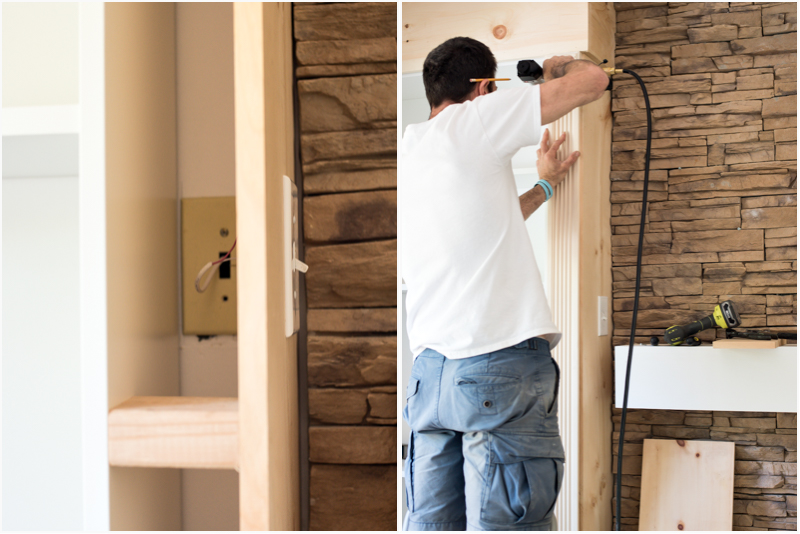
Next, measure and cut the millwork to length, and brad nail that into place.
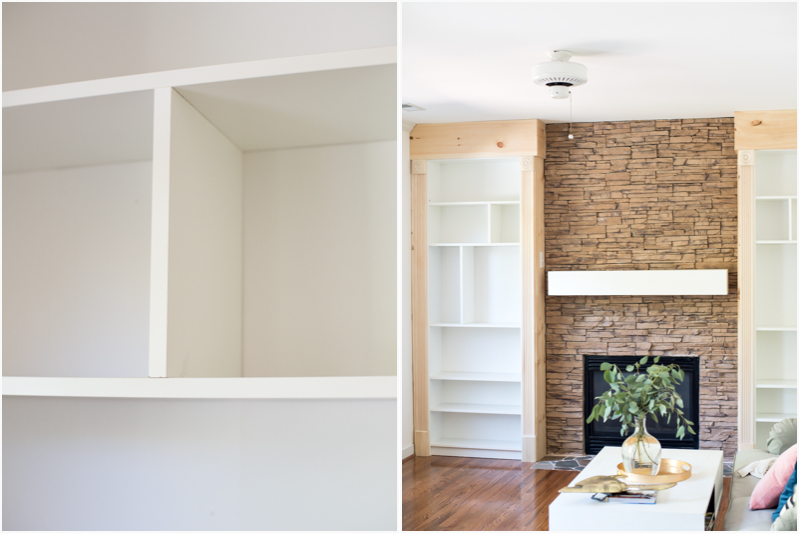
Arrange shelves as desired. I cut a few in half to make the vertical breaks and used another 1″ x 12″ to fill the remaining longer gaps to my liking.
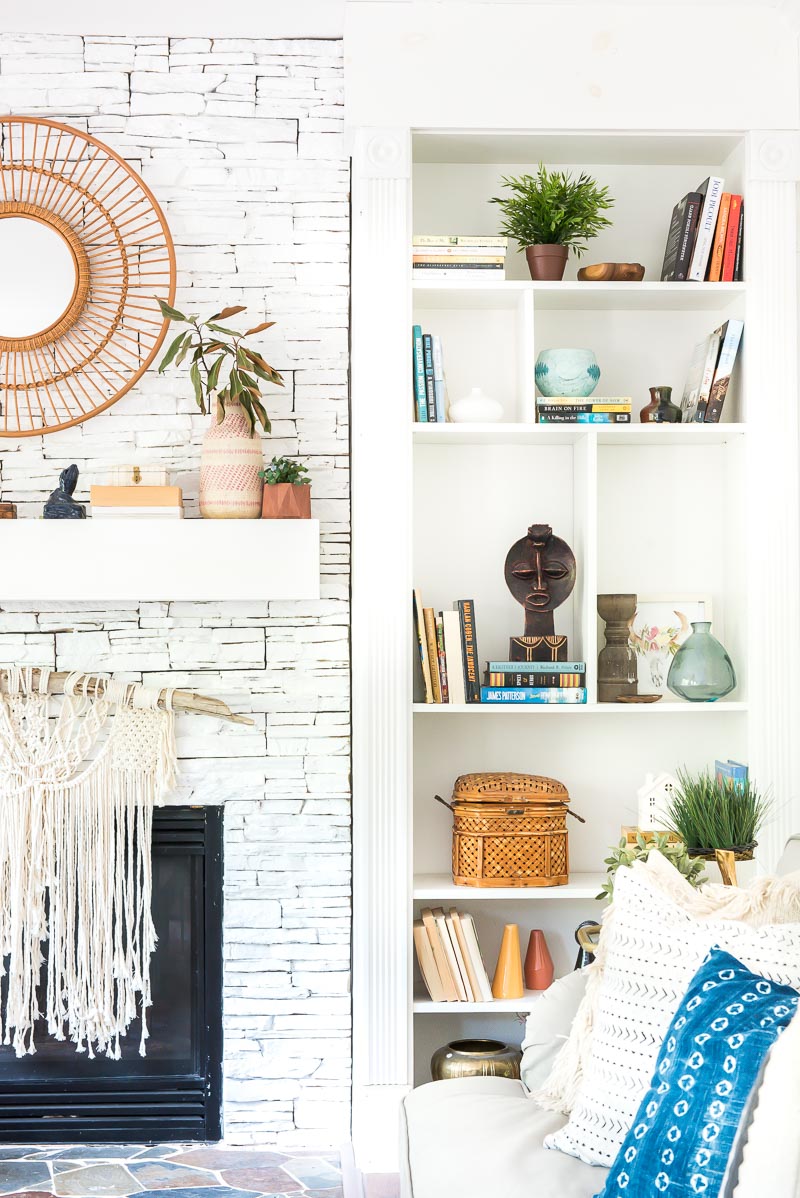
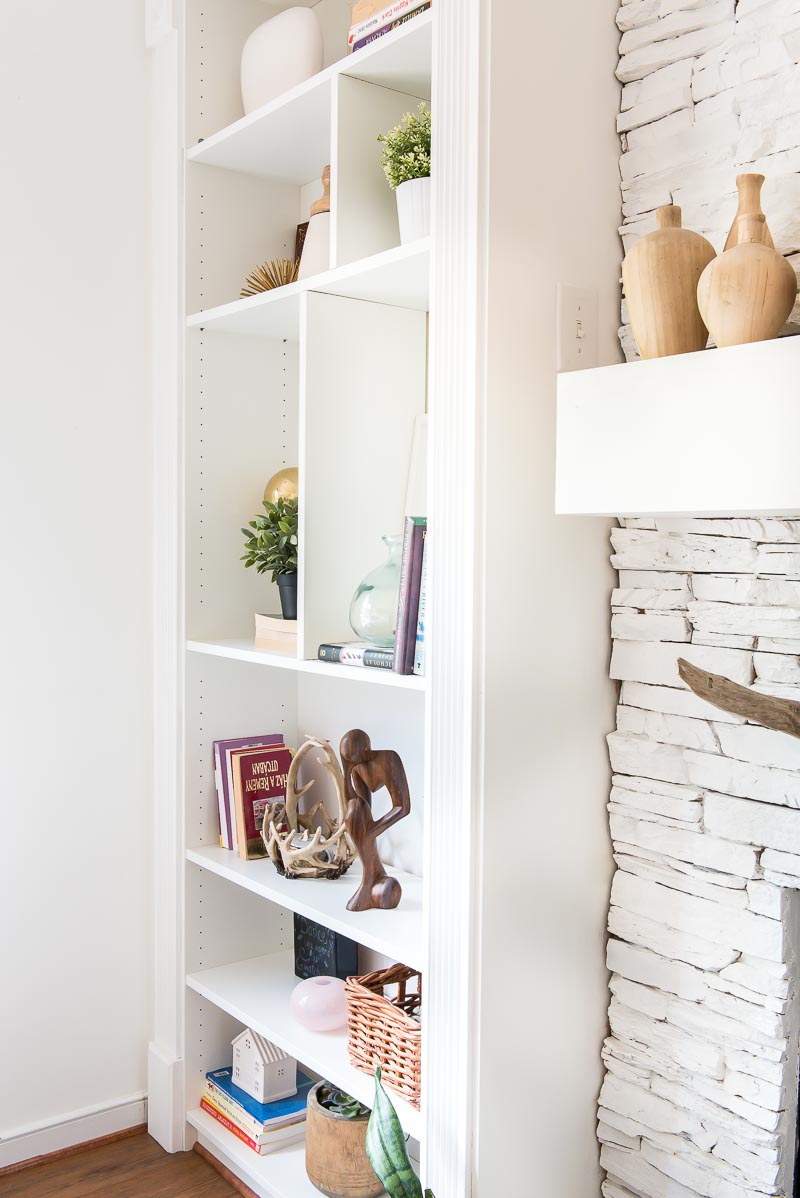
Paint, stain and decorate as desired. Here’s our finished product!
Now it’s time to invite your friends over to enjoy your upgraded space and spoil you with compliments on the fruits of your labor … manual labor, but it was worth it, right?!
These are pretty much guaranteed to be a clutch selling feature if you do decide to put your house on the market. In the meantime, I hope you love your new custom built-in bookcases as much as I love mine!
If you want good neighbors, you’ll first have to become one yourself. Master these seven techniques, and even you (yes, you!) can win the approval of your entire neighborhood.
1. Good neighbors bring cookies
Whether you’re new in town or haven’t kept in touch, a delivery of freshly baked goods is a perfect way to break the ice and let neighbors know that you’re thinking of them.
If cookies can keep Santa returning year after year with a bag full of loot, then surely they can train your neighbors to do your bidding. Consider the following scenario.
“Honey, somebody’s robbing the neighbor’s house again.”
“Wait, Janet. The ones who brought cookies yesterday?”
“Exactly. This time I’ll call the cops.”
2. Good neighbors rarely gossip
If your neighbor seems to know the dirt on everyone within a two-block radius, you can count on them to keep tabs on your personal life as well.
The next time Nosy Nellie gleefully describes the contents of the Rickenbacker’s trash again, move the conversation along by refocusing the conversation on her. “So, what are you growing in your garden this year?”
You aren’t in high school anymore, so preserve relationships with your neighbors and avoid the gratuitous gab fests.
3. Good neighbors share phone numbers
For such a connected age, you should really question why you don’t have your neighbors’ phone numbers. After all, what if they receive your package by mistake? What if the house floods while you’re on vacation? Worse yet, what if you need a babysitter?
If you feel uncomfortable bringing it up, ask during one of your cookie deliveries (you are following rule number one, right?) or right before a trip. Jot down your name, number and email address on a piece of paper and ask if your neighbor is comfortable sharing theirs.
4. Good neighbors help before they’re asked
The neighbor who says, “Let me know if you need anything,” probably isn’t going to help whenever you actually need something. You, on the other hand, are a good neighbor and genuinely want to help out.
To get ahead of the meaningless small talk, anticipate their needs. If they have kids and you’re comfortable babysitting, tell them up front. If they’re clearly struggling to mow the lawn during a heat wave, ask for the best time to stop by with your lawnmower.
5. Good neighbors are tidy
Even if you lack self-respect, respect the sensitive tastes of others and clean up your act.
Keep the ironic lawn ornaments to a minimum. Keep trash receptacles hidden in the side yard, or better yet, the garage.
Whenever you’ve finished gardening or landscaping for the day, put away your tools and bags of unused mulch. Rake the leaves and clean up grass clippings and all the other stuff your dad used to bug you about.
And if it’s not too much trouble, pressure wash and paint your house periodically.
6. Good neighbors mow the lawn
An unkempt and weedy lawn is embarrassing for your neighbors, so it should be embarrassing for you as well. Keeping it mowed every week or two is a good start, but it will take more than that to win the approval of the locals.
Trim the edge of your lawn regularly, fertilize on schedule and keep weeds to a minimum. Keep your foundation plantings simple, neatly trimmed and topped off with mulch.
If your neighborhood allows it, go the no-lawn method by planting swaths of low-maintenance, drought-tolerant ground covers. Crucially, don’t overdo it on the sprinklers — especially when it’s raining.
7. Good neighbors communicate
That old “good fences make good neighbors” quote had to come up at some point, right? A good neighbor must respect boundaries. That said, they should also be crossed when the fences themselves start losing pickets and falling over in a storm.
Even if it’s technically their fence, you might not be happy with the shoddy workmanship and resentment that you’ll have to live with when they get around to fixing it themselves.
Address shared interests like fences, drainage ditches and troublesome trees ahead of time so that you can work out a plan that both parties can agree to.
Mortgage rates dropped slightly this week, but overall, they were mostly flat, offering some temporary relief to borrowers.
Mixed economic data this week prompted mortgage rates to remain in mostly a holding pattern, says Sam Khater, Freddie Mac’s chief economist. “Manufacturing output and consumer spending showed improvements, but construction activity was a disappointment,” Khater says. “This meant there was no driving force to move mortgage rates in any meaningful way, which has been the theme in the last two months. That’s good news for price-sensitive home shoppers, given that this stability in borrowing costs allows them a little extra time to find the right home.”
Freddie Mac reports the following national averages with mortgage rates for the week ending July 19:
30-year fixed-rate mortgages: averaged 4.52 percent this week, with an average 0.5 point, dropping slightly from last week’s 4.53 percent average. Last year at this time, 30-year rates averaged 3.96 percent.
15-year fixed-rate mortgages: averaged 4 percent this week, with an average 0.4 point, falling from last week’s 4.02 percent average. A year ago, 15-year rates averaged 3.23 percent.
5-year hybrid adjustable-rate mortgages: averaged 3.87 percent, with an average 0.3 point, rising from last week’s 3.86 percent average. A year ago, 5-year ARMs averaged 3.21 percent.