Contract Signings Cool as More Buyers Are Priced Out | #BayAreaPrices #TalkToYourAgent #SiliconValleyAgent #YajneshRai #YourAgentMatters #01924991

Facebooktwitterpinterestlinkedin

Contract Signings Cool as More Buyers Are Priced Out | Realtor Magazine

Contract signings to purchase a home fell in July, marking the seventh consecutive month that pending home sales have dropped on an annual basis, the National Association of REALTORS® reported Wednesday.

NAR’s Pending Home Sales Index, a forward-looking indicator based on contract signings, fell 0.7 percent to a reading of 106.2 in July. Contract signings are down 2.3 percent year over year. Declines in the South and West weighed down overall activity in last month’s index, NAR notes.

“It’s evident in recent months that many of the most overheated real estate markets—especially those out West—are starting to see a slight decline in home sales and slower price growth,” says Lawrence Yun, NAR’s chief economist. “The reason sales are falling off last year’s pace is that multiple years of inadequate supply in markets with strong job growth have finally driven up home prices to a point where an increasing number of prospective buyers are unable to afford it.”

Yun says inventories are rising in some large metros, notably out West including Denver; Santa Rosa, Calif.; San Jose-Sunnyvale-Santa Clara, Calif.; Seattle; and Portland, Ore. The uptick in inventories will likely help moderate price growth, he says.

“Rising inventory levels, especially if new home construction finally starts picking up, should help slow price appreciation to around 2 and 4 percent, which will help aspiring first-time buyers, and be good for the long-term health of the nation’s housing market,” Yun says.


July 2018 Pending Home Sales - Content reflects article text.

© National Association of REALTORS®

Facebooktwitterpinterestlinkedin

First-Time Buyers Have Bought 985K Homes This Year | #FirstTimeHomeBuyers #TalkToYourAgent #SiliconValleyAgent #YajneshRai #YourAgentMatters #01924991

Facebooktwitterpinterestlinkedin

First-Time Buyers Have Bought 985K Homes This Year | Realtor Magazine

Home sales may be slowing overall, but not among first-time home buyers, according to a new report. Genworth Mortgage Insurance culled all publicly available government and proprietary mortgage industry data to see how this segment of buyers is faring in the housing market. In the first half of the year, first-time buyers purchased 985,000 single-family homes, the most during the first six months of a year since 2005, according to Genworth’s First-Time Homebuyer Report.


Couple holding keys with a carboard box

© Jean-philippe WALLET – iStock/Getty Images Plus


In the second quarter, first-time home buyers purchased 572,000 single-family homes, up just 1 percent from a year ago. But it’s the six-month snapshot over this year so far that economists say is important to take note of.

“The market needs to put this quarter’s slowdown in first-time home buyer purchase growth in context,” says Tian Liu, Genworth’s chief economist. “Because while quarterly first-time home buyer purchase growth was nominal, on a semiannual basis this group recorded the most single-family home purchases since 2005. That is impressive considering overall home sales declined by 2 percent during the second quarter, with unusually slow activity in June.”

The decrease in overall home sales was driven by an uptick in interest rates and home prices, which together raised monthly mortgage payments for first-time home buyers by 12.6 percent year over year, according to the report. Also, many markets have seen a decrease in supply of homes in the “affordable range” of $150,000 to $300,000, according to the report.

Despite all of this, home buyers under the age of 35 have been increasing their homeownership rates and “showing a determination and resiliency to become homeowners,” according to the report.

First-time home buyers have a wide range of low down payment mortgage products available, which account for 79 percent of their home purchase transactions, Liu says. Conventional loans with mortgage insurance have grown in popularity—in the latest quarter, for the first time, these loans have become the largest source of credit to first-time home buyers, according to the report.

“It is remarkable that the first-time home buyer market has remained so resilient so far this year, reaching its highest level since 2005,” Liu notes in the report. “It shows the tremendous potential from this market segment.”

Facebooktwitterpinterestlinkedin

5 Ways to Get to Know Your Neighbors | #NewNeighbors #TalkToYourAgent #SiliconValleyAgent #YajneshRai #YourAgentMatters #01924991

Facebooktwitterpinterestlinkedin

5 Ways to Get to Know Your Neighbors

Leaving friends and neighbors behind can be the toughest part of moving to a new home.

These five tips will help you make connections and settle into your new community in no time.

1. Knock, knock

For an extrovert, walking over to a neighbor’s home to say hello may feel like a no-brainer. But for more reserved personalities, this tried-and-true method usually requires a bit of a warmup.

Start with a friendly wave as you drive by, then work your way up to a face-to-face introduction. Remember, timing is everything. You don’t want to disturb your neighbors in the middle of dinner or while they’re struggling to get a fussy toddler down for the night.

Try to catch them when they’re already outside, or aim for a weekend afternoon when everyone is much more likely to be relaxed and open to a brief, friendly chat.

2. Snail mail

Can’t work up the nerve to knock on doors? In this age of electronic communication, a nice handwritten note can be a welcome surprise.

Write a few lines for your closest neighbors, introducing yourself and inviting them over for a cup of coffee or cocktail at their convenience.

Be sure to personalize each note by including a small conversation starter (e.g., the roses in front of your home are absolutely stunning! We’re poodle lovers too!), then drop your letters at your neighbors’ front door or in their mailbox.

3. Magic school bus

If you’ve got school-age children, accompany them to the bus stop for the first few days of class.

You’re likely to run into at least one other parent who can fill you in on both neighborhood and school happenings — and people love to talk about their kids, so you won’t have to worry about awkward silences and finding common ground.

Exchange contact info and invite the family over for some weekend fun.

4. Man’s best friend

Our pets often are the friendliest members of the family, so let your four-legged companion break the ice for you.

Dog parks are a natural spot for meeting new friends, both canine and human. You can also meet fellow pet lovers while walking your dog through your neighborhood — cleaning up any messes, of course.

You can get recommendations for trails, vets and parks, as well as ask about any pet-themed meetups in the area.

5. Turn the page

Don’t let the name fool you: Book clubs are as much about socializing as they are about reading.

Check out your library or local bookstore for groups near you, or you can find one online. If possible, contact the host ahead of time to ask whether you should bring any refreshments (wine!), and come armed with a few key insights about the book and recommendations for the next session.

Who knows? You could pick the next talk of the town.

Bonus: life of the party

Once you’ve made a few connections, team up to host a neighborhood block party. Volunteer to handle snacks and other logistics, and ask your more established neighbors to spread the word.

Pick a seasonal theme — hot dogs and lemonade for summer, cookies and warm cider for fall — and spend an afternoon meeting new friends and getting the inside scoop on the best places to eat and play near your new home.

Before you call it a day, pass the torch to another neighbor and make the block party a new tradition.

Facebooktwitterpinterestlinkedin

5 Expenses Homeowners Pay That Renters Don’t | #ThingsToExpect #TalkToYourAgent #SiliconValleyAgent #YajneshRai #YourAgentMatters #01924991

Facebooktwitterpinterestlinkedin

5 Expenses Homeowners Pay That Renters Don’t

Homeownership may be a goal for some, but it’s not the right fit for many.

Renters account for 37 percent of all households in America — or just over 43.7 million homes, up more than 6.9 million since 2005. Even still, more than half of millennial and Gen Z renters consider buying, with 18 percent seriously considering it.

Both lifestyles afford their fair share of pros and cons. So before you meet with a real estate agent, consider these five costs homeowners pay that renters don’t — they could make you reconsider buying altogether.

1. Property taxes

As long as you own a home, you’ll pay property taxes. The typical U.S. homeowner pays $2,110 per year in property taxes, meaning they’re a significant — and ongoing — chunk of your budget.

Factor this expense into the equation from the get-go to avoid surprises down the road. The property tax rates vary among states, so try a mortgage calculator to estimate costs in your area.

2. Homeowners insurance

Homeowners insurance protects you against losses and damage to your home caused by perils such as fires, storms or burglary. It also covers legal costs if someone is injured in your home or on your property.

Homeowners insurance is almost always required in order to get a home loan. It costs an average of $35 per month for every $100,000 of your home’s value.

If you intend to purchase a condo, you’ll need a condo insurance policy — separate from traditional homeowner’s insurance — which costs an average of $100 to $400 a year.

3. Maintenance and repairs

Don’t forget about those small repairs that you won’t be calling your landlord about anymore. Notice a tear in your window screen? Can’t get your toilet to stop running? What about those burned out light bulbs in your hallway? You get the idea.

Maintenance costs can add an additional $3,021 to the typical U.S. homeowner’s annual bill. Of course, this amount increases as your home ages.

And don’t forget about repairs. Conventional water heaters last about a decade, with a new one costing you between $500 to $1,500 on average. Air conditioning units don’t typically last much longer than 15 years, and an asphalt shingle roof won’t serve you too well after 20 years.

4. HOA fees

Sure, that monthly mortgage payment seems affordable, but don’t forget to take homeowners association (HOA) fees into account.

On average, HOA fees cost anywhere from $200 to $400 per month. They usually fund perks like your fitness center, neighborhood landscaping, community pool and other common areas.

Such amenities are usually covered as a renter, but when you own your home, you’re paying for these luxuries on top of your mortgage payment.

5. Utilities

When you’re renting, it’s common for your apartment or landlord to cover some costs. When you own your home, you’re in charge of covering it all — water, electric, gas, internet and cable.

While many factors determine how much you’ll pay for utilities — like the size of your home and the climate you live in — the typical U.S. homeowner pays $2,953 in utility costs every year.

Ultimately, renting might be more cost-effective in the end, depending on your lifestyle, location and financial situation. As long as you crunch the numbers and factor in these costs, you’ll make the right choice for your needs.

Facebooktwitterpinterestlinkedin

Small Kitchen? Try These 9 Tips for Making the Most of Your Limited Space | #SpaceManagement #TalkToYourAgent #SiliconValleyAgent #YajneshRai #YourAgentMatters #01924991

Facebooktwitterpinterestlinkedin

Small Kitchen? Try These 9 Tips for Making the Most of Your Limited Space

Is there some kind of law that requires rental apartments to supply no more than a single square of kitchen counter space to each unit?

Between the white walls, scarce and often outdated cabinets, and a lack of amenities, it’s rare to find a solid kitchen in the world of yearlong leases.

But no good makeover starts with a beautiful subject, right?

All you need to transform that bleak little kitchen into a well-designed, functional space is a bit of imagination, some basic home maintenance skills, and a few solid pieces.

Here’s where to begin.

Donate first

Before moving into your new space, make sure to get rid of all those things you don’t need anymore.

Have you actually used that discounted bundt pan in the past year or two? If not, donate to your favorite local charity shop. Someone else might get use out of it, and you’ll be saving yourself from more clutter in your new home.

Think vertically

Vertical storage is a tried-and-true method of using space, and the kitchen holds some unique opportunities for making the most of it.

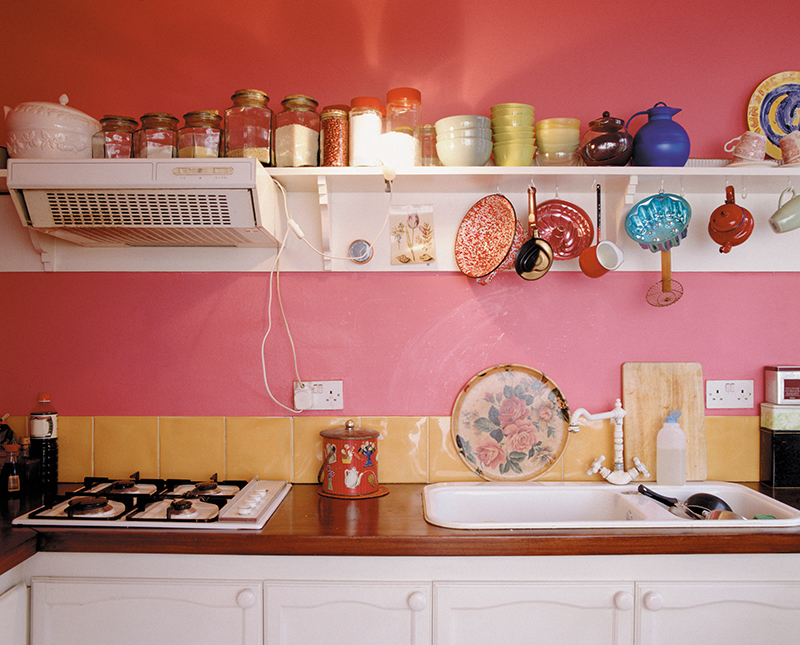
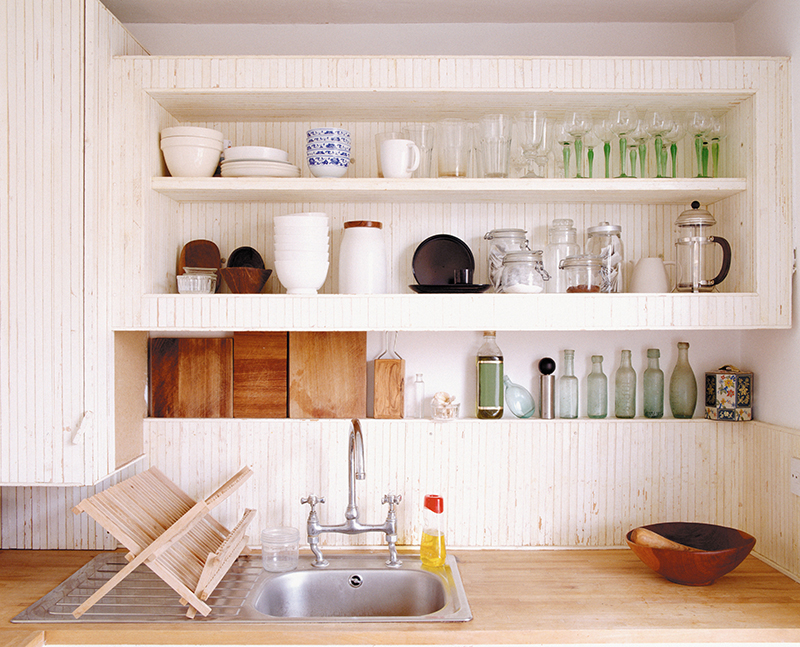
Hanging pot racks, magnetic knife strips, mounted dish-drying racks installed above the sink, and rods with hooks for towels, aprons, small tools and oven mitts are all excellent ways to keep clutter in its place — and keep the surfaces and lower area of the room free.
Find beautiful cleaning tools

The ugly truth is that a lot of everyday items just make sense to keep out — but that doesn’t mean they have to be such an eyesore.

Skip the plastic and get yourself a classic wooden broom, natural fiber dish brush and a glass soap dispenser. These items don’t cost much, but they add a softer look while also getting the job done.

Tap into change

Just because your place didn’t come equipped with a dishwasher doesn’t mean you have to suffer. Installing a quality faucet with a pull-down sprayer can make your chores less of a chore (and, as long as you swap it back before you move out, it shouldn’t violate your rental agreement).

Have space and the budget for something more? Portable dishwashers are a massive timesaver. From small countertop models to wheeled butcher-block-top options, there are sizes that fit into almost any space and require nothing more than your standard sink to function.

Live the island life

A kitchen island is a versatile tool for almost any space — even the tiniest micro apartments!

Whether you choose a larger center-of-the-room-style piece or a small butcher-block number, these additions create more counter space and storage, all in one piece.

Bonus: If your island has wheels, it can serve as a portable bar for your next party. (Hey, if we can call bingeing our favorite shows with a few of our closest friends a “party,” so can you.)

Light it up

Another timeless tip: Good lighting is everything.

If your kitchen is dedicated to getting things done and starting your day, invest in cool lighting — the kind that washes everything in a bright, sunlit glow. A refreshing, cooler light wakes us up and creates an invigorating feeling.

If you’re more of a romantic and enjoy taking your time in the kitchen, keep relaxing, warm lighting around so that you can let the day melt away as you sip your merlot.

For those who prefer a bit of both, app-enabled bulbs can customize the mood for any occasion, and some even use every color of the rainbow.

Think (temporarily) BIG

If there’s one common complaint about renting, it’s the stark white walls. Removable wallpaper adds a touch of personalization and won’t break the bank — or at least, it doesn’t have to.

To keep costs low, stick to one accent wall. Finding a large-scale print will make the space feel larger, and layering a sizable mirror on top will maximize the look and any light.

Curate unique displays

One of the best ways to keep an assortment of oddly shaped kitchen items is to dedicate either one section of the room (think: the top 12 inches of the walls) or one wall to showing them off.

Whether it’s your grandmother’s antique creamer collection or the jumble of cookie cutters that won’t fit into your drawers, making them into a vignette adds a layer of personalization to your space while also providing covert storage in plain sight. Easy-to-install hooks or some simple shelves are great ways to achieve this solution.
Keep it alive

Every room deserves a plant. Not only do they look good, but they also improve the quality of the air around them. If you don’t have the floor or counter space to spare, a hanging plant will do the trick.

No natural light in your kitchen? Or perhaps you’re better at killing plants than keeping them green? No matter — there are plenty of realistic artificial plants these days, which means everyone can benefit from the organic shapes of ferns, succulents and the ever-popular fiddle-leaf figs.

Have pets? Make sure to check the toxicity of your plants before choosing their placement.

No matter how uniquely challenging your space might be, there are solutions waiting for you to find them.

Facebooktwitterpinterestlinkedin

Smart-Home Gadgets Buyers Will Pay Extra to Have | #Today’sGadgets #TalkToYourAgent #SiliconValleyAgent #YajneshRai #YourAgentMatters #01924991

Facebooktwitterpinterestlinkedin

Smart-Home Gadgets Buyers Will Pay Extra to Have | Realtor Magazine

More builders are outfitting newly constructed homes with smart-home technology, and many buyers say they’ll pay extra for it, according to research from John Burns Real Estate Consulting. Sixty percent of home shoppers say they’d spend more on a home with a smart thermostat, the consulting firm’s survey of more than 23,000 shows. Slightly more—67 percent—say they’d pay extra for an oversized kitchen.


Person using smart-home app

© Westend61/Getty Images


More than 60 percent of new-home buyers also say they’d pay more for an exterior security camera and smart locks.

In a separate John Burns survey of more than 300 home builders, 53 percent say they incorporate smart-home technology into new construction. Even so, 42 percent of buyers say they would purchase additional technology.

John Burns Real Estate Consulting found some differences among certain segments of buyers regarding which smart-home tech they find most attractive, including:

  • Young singles and couples: most likely to choose smart thermostats.
  • Families: most likely to choose a smart garage that is responsive to app controls and voice commands.
  • Older buyers: most likely to pay extra to have smart locks.

Below, watch a presentation of Todd Tomalak, senior vice president of research at John Burns Real Estate Consulting, sharing more insights into the survey findings on the popularity of smart home tech.

Facebooktwitterpinterestlinkedin

9 Ways to Unclog Your Kitchen Sink Drain | #CloggedSinkDIY #TalkToYourAgent #SiliconValleyAgent #YajneshRai #YourAgentMatters #01924991

Facebooktwitterpinterestlinkedin

9 Ways to Unclog Your Kitchen Sink Drain | Home Matters

DIY home projects are great for saving money and enjoying a good challenge, but these household projects are better left for professionals.

Running water in sink

It can be a helpless feeling when the kitchen sink won’t drain. With water backing up and a counter full of dirty dishes waiting to be cleaned, it may be tempting to reach for the phone and dial the plumber. Before you do, read these easy, do-it-yourself ways to unclog that drain.

1. Boiling water

This is the easiest and least expensive solution of all, which makes it the best one to try first. Place a kettle or pot of water on the stove and bring to a rolling boil. While you’re waiting for the water to heat, remove as much standing water from the sink as you can, using a mug or small pot to bail out the water. Then, pour the entire kettle of water into the sink and wait. If the water stands in the sink and the clog doesn’t move, give the water time to cool and remove it to try again. You may need to repeat the process several times to move the clog, but this often works on many types of stoppage.

2. Disposal

Check to make sure it’s not your garbage disposal that’s causing the problem. A clogged disposal can stop up the drain, so run the disposal to see if that clears the clog. Then inspect it to make sure it’s running correctly. If the disposal has overheated, you may need to flip the switch found on the side or bottom of the unit underneath the sink.


3. Salt and boiling water

After removing standing water from the sink, pour about ½ cup of table salt down the drain before you pour in the boiling water. Let it sit for a few minutes, and then flush with hot water to clear the mixture.

4. Vinegar and baking soda

 Again, remove standing water first. Pour about a cup or so of baking soda into the drain, followed by an equal amount of white or apple cider vinegar. The solution will bubble, but when they subside, put the stopper in and wait about 15 minutes. Next, run hot water to see if the clog clears. Repeat if needed.

5. Baking soda and salt

This is another combination that can work on sink clogs. Mix about a cup of baking soda with a half-cup of salt, and pour down the drain. Let the mixture sit for several hours, then flush with boiling water. You can repeat this process if it doesn’t work the first time.

Looking for an affordable home warranty plan, shop:
– Home Warranty Plans
– View Home Warranty Coverage
– Home Appliance Warranty Plans

6. Plunger

 If these combinations aren’t successful in unclogging your sink, reach for a common household plunger. If you have a double sink, first seal off the second side with a wet cloth or a stopper. You’ll need to create a tight seal around the plunger, so fill the side of the sink you intend to plunge with enough water to cover the bell of the plunger. Place the plunger firmly over the drain and plunge vigorously several times. When you hear the suction clear the clog, remove the plunger and flush the drain well with warm water.

7. P-trap

 It may be necessary to clean your kitchen drain’s P-trap to clear the clog. The P-trap is at the curve of the drainpipe under the sink, usually inside a cabinet. Place a pan or bucket underneath the drain to catch any water or debris that may fall out. Unfasten the P-trap from the drainpipe and clear out anything that is stuck. Then replace and run water through it.

8. Plumber’s snake

Sometimes called an auger, this handy tool can clear clogs that may be stuck further down the system. You’ll have to disassemble the drainpipe and P-trap that runs underneath the kitchen sink to expose the “stub pipe” or “stubout” that travels behind the cabinet wall. This is where you insert the snake into the pipe until you feel resistance to break up the clog.

9. Coat hanger

If you don’t have a plumber’s snake, you can use a wire coat hanger by straightening it. Of course, it won’t reach as far as a plumber’s snake would, but it may be long enough to reach some clogs. Insert it into the kitchen drain or stub pipe to push through or pull out the clog if you can reach it. Be careful not to scratch your sink with the wire.

To keep your sink smelling fresh and running clear, pour in equal parts of vinegar and baking soda on a regular basis. For routine cleaning, you’ll just need about one-half cup of each. Let the mixture sit for a few minutes before running some warm water down the drain. You can also use lemon juice for the same purpose.

Of course, it’s always easier to avoid clogs in the first place. If you have a kitchen garbage disposal, don’t overload it. Feed items in a little at a time, and wait until they grind and run through completely before adding more. Never put bacon grease, coffee grounds or oils down your kitchen drain, and always make sure you run plenty of water down the drain after each use. It’s important to know how to maintain and care for your all your home’s plumbing components and systems to keep things running smoothly.

Facebooktwitterpinterestlinkedin

Mortgage Rates Fall for Third Straight Week | #MortgageRates #TalkToYourAgent #SiliconValleyAgent #YajneshRai #YourAgentMatters #01924991

Facebooktwitterpinterestlinkedin

Mortgage Rates Fall for Third Straight Week | Realtor Magazine


Mortgage rates for 30, 15, ARM. Full information at http://www.freddiemac.com/pmms/

© National Association of REALTORS®


Borrowers continued to get relief with mortgage rates this week, as the 30-year fixed-rate mortgage sank lower for the third consecutive week. Mortgage rates are now at their lowest level since mid-April.

“Backed by very strong consumer spending, the economy is red-hot this month, which is in turn rippling through the financial markets and driving equities higher,” says Sam Khater, Freddie Mac’s chief economist. “Unfortunately, the same cannot be said about the housing market, where it appears sales activity crested in late 2017. Existing-home sales have now stepped back annually for the fifth straight month, and purchase mortgage applications this week were barely above year ago levels.”

Khater notes that “it is clear affordability constraints” have cooled the housing market, particularly in expensive coastal markets. “Many metro areas desperately need more new and existing affordable inventory to break out of this slump,” he notes.

Freddie Mac reports the following national averages with mortgage rates for the week ending Aug. 23:

  • 30-year fixed-rate mortgages: averaged 4.51 percent, with an average 0.5 point, falling from last week’s 4.53 percent average. Last year at this time, 30-year rates averaged 3.86 percent.
  • 15-year fixed-rate mortgages: averaged 3.98 percent, with an average 0.5 point, falling from last week’s 4.01 percent average. A year ago, 15-year rates averaged 3.16 percent.
  • 5-year hybrid adjustable-rate mortgages: averaged 3.82 percent, with an average 0.3 point, down from last week’s 3.87 percent average. A year ago, 5-year ARMs averaged 3.17 percent.
Facebooktwitterpinterestlinkedin

Jumbo Loans May Be More Practical for Average Buyers | #JumboLoans #TalkToYourAgent #SiliconValleyAgent #YajneshRai #YourAgentMatters #01924991

Facebooktwitterpinterestlinkedin

Jumbo Loans May Be More Practical for Average Buyers | Realtor Magazine

Large-balance mortgage loans called “jumbo” loans are becoming less expensive than conforming loans. Traditionally, jumbo loans have carried higher interest rates, but since mid-2013 that has been gradually changing. Jumbo loan rates have been less expensive to borrow than a conforming mortgage loan by an average of 33 basis points during the first quarter, according to CoreLogic, a real estate data firm, on its Insights Blog.


Jumbo loans

© alashi – DigitalVision Vectors/Getty Images


In response, jumbo loans have been growing. The share of jumbo loans has reached its highest rate since 2009 at about 15 percent of home-purchase originations, CoreLogic reports. For comparison, in 2009, the jumbo share was just 6 percent.

Jumbo loans are those that exceed the high-balance conforming loan limit, which the Federal Housing Finance Agency set at $453,100 for most of the U.S. in 2018. Areas designated as high-cost may stretch up to $679,650.

CoreLogic researchers say one of the reasons that the jumbo-to-conforming rate difference has seen the gap decline is the increase in guarantee fees, also known as g-fees. These are fees on loans bought by Fannie Mae and Freddie Mac for conforming and high-balance conforming loans. The average g-fee has nearly tripled since 2010, jumping from 22 basis points to 57 basis points in 2017.

“Since jumbo loans are too big to be purchased by Fannie Mae and Freddie Mac, those fees have little or no impact on the note rate of the jumbo loans,” CoreLogic notes on its Insights Blog. “Fannie Mae and Freddie Mac are pricing the credit risk of conforming loans, while banks are pricing the credit risk of jumbo loans. Thus, increase in guarantee fees has the effect of raising interest rates for conforming loans with little or no impact on the mortgage rates for jumbo loans.”

Researchers also note that lenders are requiring higher credit standards to get a jumbo loan, which has lowered the credit risk to lenders and given them more incentive to issue them. The average credit score for buyers with a 30-year fixed-rate jumbo loan is 18 points higher than for buyers with conforming loans.

Facebooktwitterpinterestlinkedin

Existing-Home Sales Reach Slowest Pace in 2 Years | #GoodTimeToBuy #TalkToYourAgent #SiliconValleyAgent #YajneshRai #YourAgentMatters #01924991

Facebooktwitterpinterestlinkedin

Existing-Home Sales Reach Slowest Pace in 2 Years | Realtor Magazine

Existing-home sales slowed for the fourth consecutive month in July, reaching their most sluggish pace in more than two years, the National Association of REALTORS® reports. The West was the only major U.S. region to see an increase in sales last month.

Total existing-home sales, which include completed transactions for single-family homes, townhomes, condos, and co-ops, fell 0.7 percent month over month to a seasonally adjusted annual rate of 5.34 million in July. Sales are now 1.5 percent lower than a year ago.

Rising home prices may be prompting would-be home buyers to pull away, says NAR Chief Economist Lawrence Yun. “Led by a notable decrease in closings in the Northeast, existing-home sales trailed off again last month, sliding to their slowest pace since February 2016 at 5.21 million [units],” Yun says. “Too many would-be buyers are either being priced out or are deciding to postpone their search until more homes in their price range come onto the market.”

Yun notes that a steady climb in home prices over the past year—along with an uptick in mortgage rates this spring—is cooling sales. “This weakening in affordability has put the most pressure on would-be first-time buyers in recent months, who continue to represent only around a third of sales despite a very healthy economy and labor market,” he says. First-time buyers comprised 32 percent of sales in July, down from 33 percent a year ago.

Here’s a closer look at some key indicators from NAR’s July housing report:

  • Home prices: The median existing-home price for all housing types was $296,600, a 4.5 percent increase from a year ago.
  • Inventories: Total housing inventory fell 0.5 percent to 1.92 million existing homes available for sale, unchanged from a year ago. At the current sales pace, unsold inventory is at a 4.3-month supply.
  • Days on the market: Fifty-five percent of homes sold were on the market for less than a month. Properties typically stayed on the market for 27 days, down from 30 days a year ago. “Listings continue to go under contract in under a month, which highlights the feedback from REALTORS® that buyers are swiftly snatching up moderately-priced properties,” Yun says. “Existing supply is still not at a healthy level, and new-home construction is not keeping up to meet demand.”
  • All-cash sales: All-cash transactions compromised 20 percent of sales, up from 19 percent a year ago. Individual investors tend to account for the biggest bulk of cash sales. They purchased 13 percent of homes, unchanged from a year ago.
  • Distressed sales: Foreclosures and short sales accounted for 3 percent of sales, down from 5 percent a year ago. Broken out, 2 percent of sales were foreclosures, and 1 percent were short sales.
Facebooktwitterpinterestlinkedin