A Third of Employees Want to Work From Home Permanently | #YajneshRai #01924991 #TeamYaj #SangeetaRai #02026129

Facebooktwitterpinterestlinkedin

A Third of Employees Want to Work From Home Permanently | Realtor Magazine

As states begin to reopen, many workers are hesitating as their workplaces unlock their doors. About one-third of employees—35% recently surveyed—say they prefer to continue working from home permanently, according to a new survey conducted in late May by CreditCards.com.

Workers showed a preference for working from home even though they say it is costing them more. Remote workers surveyed say their regular expenses have increased by $108, reflecting an increase in groceries and utilities, even if they are saving on child care, gas or public transportation, and clothing and dry cleaning costs. Millennials found it even more costly—an increase of $208 above their regular monthly expenses.

“Surprisingly, average expenses have gone up for people working from home, but it’s a trade-off most are happy with,” says Ted Rossman, an industry analyst with CreditCards.com. “Most workers seem content to skip the commute and potentially work in their pajamas, even if it means spending more on food and utilities.”

As the COVID-19 pandemic first struck the U.S., about one-third of employed U.S. adults were estimated to have been able to work from home.

While 35% of survey respondents said they want to work from home permanently, according to the survey, the majority are in favor of a hybrid office and home setup. Eighty-two percent of employees said they would like to work from home at least two days per week (that includes respondents who mostly said they would like to work from home full-time). Twenty-one percent of respondents said they would like to work from home four days or more per week, and only 7% of respondents said they wanted to work from home just one day per week.

The commercial sector is working to predict what trends will surface in office space needs post-pandemic. Leasing and investment sales activity reportedly is gradually coming back in some areas as states reopen. Robert Cleary, senior vice president specializing in the office sector with Colliers International, told the National Real Estate Investor that he believes suburban office markets will see a pickup in activity. Satellite offices likely will grow in demand as an alternative to trekking to urban locales.

Jonathan Stravutz with SDB-BIOC Commercial says he expects employees will switch between working from home and the office, at least in the interim. He believes that typically only 30% of office space will be occupied at a time, and the trend likely will continue until a vaccine for the coronavirus is found. He expects more sublet space to come onto the market. But real estate pros also report some office tenants are leveraging an advantage in negotiating deals to still scoop up space in prime urban spots during the pandemic.

“Most occupiers are evaluating their current and future space needs to support both an increasingly remote workforce and less office density for health and safety reasons,” Dennis Hearst, senior vice president in the advisory and transactions services group with CBRE, told the National Real Estate Investor. He remains optimistic. “The unmatched value of a dedicated space for commercial innovation and professional collaboration will endure, even if some long-term design changes occur,” he adds.

Facebooktwitterpinterestlinkedin

Mortgage Rates Remain Low for Buyers Who Can Qualify | #YajneshRai #01924991 #TeamYaj #SangeetaRai #02026129

Facebooktwitterpinterestlinkedin

Mortgage Rates Remain Low for Buyers Who Can Qualify | Realtor Magazine

Mortgage rates for 30, 15, ARM. Full information at http://www.freddiemac.com/pmms/

© REALTOR® MAGAZINE


The 30-year fixed-rate mortgage continued to hover near its all-time low this week, averaging 3.21%, Freddie Mac reports.

“The rebound in home buyer demand continued this week, driven by mortgage rates,” says Sam Khater, Freddie Mac’s chief economist. “This turnaround in demand, particularly by those who have higher incomes than the typical household, also reflects deferred sales from the spring.”

Freddie Mac reports the following national averages for the week ending June 11:

  • 30-year fixed-rate mortgages: average 3.21%, with an average 0.9 point, rising slightly from last week’s 3.18% average. At the end of May, 30-year rates reached a record low average of 3.15%. A year ago, 30-year rates averaged 3.82%.
  • 15-year fixed-rate mortgages: averaged 2.62%, with an average 0.8 point, unchanged from last week. Last year at this time, 15-year rates averaged 3.26%.
  • 5-year hybrid adjustable-rate mortgages: averaged 3.10%, with an average 0.4 point, unchanged from last week’s average. Last year at this time, the 5-year ARM averaged 3.51%.

Freddie Mac reports average commitment rates along with average fees and points to reflect the total upfront cost of obtaining a mortgage.

Facebooktwitterpinterestlinkedin

Americans Are Less Anxious About Paying Their Bills | #YajneshRai #01924991 #TeamYaj #SangeetaRai #02026129

Facebooktwitterpinterestlinkedin

Americans Are Less Anxious About Paying Their Bills | Realtor Magazine

As states reopen, consumers are becoming less concerned about their financial situation. About 12.6% of Americans say they were worried about being able to make a minimum debt payment in May, down from a seven-year high in April (16.2%), according to a survey of consumer expectations released by the Federal Reserve.

The 12.6% figure is in line with percentages from December, prior to the pandemic that sent a shock wave through the economy. Consumers earning between $50,000 and $100,000 felt more relief in their finances in May as states began to reopen, according to the Fed survey. In that income bracket, the percentage of consumers who were worried about making the minimum debt payments dropped from 15.9% in April to 10.3% in May.

For consumers who earn more than $100,000 annually, the percentage of those concerned about paying their bills dropped from 7.2% in April to 6.7% in May.

The largest concern in paying bills is for those who earn under $50,000 a year. In April, 22.9% worried about making their debt payments, compared to 18.7% in May.

Broken out by age, consumers over the age of 60 appear to be the least worried about their financial situation, while people under 40 are the most concerned.

On Tuesday, the National Bureau of Economic Research declared the nation is in a recession and has been in one since February. That marks the official end to the U.S.’s longest economic expansion in history that spanned more than 10-and-a-half years. More than 42 million Americans have filed for unemployment benefits since February.

However, several economists are optimistic that this recession will be short-lived and was ignited by shelter-in-place measures that left many unable to work during the COVID-19 outbreak.

Already, the U.S. Bureau of Labor Statistics announced late last week that the U.S. had added 2.5 million jobs in May—the largest monthly gain since the agency began tracking in 1939.

Also, total personal income actually grew during the pandemic lockdown due to the passage of a massive stimulus package that rushed aid to consumers affected by closures. Americans were able to save around 8% of their income prior to the pandemic but saved 33% of their income in May. 

“With many economies advancing in phases of reopening, more money will be spent and more job additions will follow,” Lawrence Yun, chief economist for the National Association of REALTORS®, said in a statement last week following the jobs report.

As for the housing market, Yun is predicting a V-shaped recovery. However, “the broader economy will not be, and the double-digit unemployment rate will persist till the end of the year,” Yun says. “Still, the latest jobs data is showing much better recovery potential.” 

Facebooktwitterpinterestlinkedin

Record Low Mortgage Rates for the Long Term? | #YajneshRai #01924991 #TeamYaj #SangeetaRai #02026129

Facebooktwitterpinterestlinkedin

Record Low Mortgage Rates for the Long Term? | Realtor Magazine

The Federal Reserve announced Wednesday that it would keep its benchmark interest rate near zero through 2022—a move that could set the course for record low mortgage rates for the next three years. The Fed’s key rate doesn’t directly affect mortgage rates, but it often influences them. The federal funds rate is what banks charge one another for short-term borrowing.

The Fed’s decision was a response to the economic impact of the COVID-19 pandemic. The Fed also announced it will continue to increase its bond holdings to help preserve the flow of credit. “The Federal Reserve’s view that a rate hike will not occur for three years is a signal to the market to expect an all-in accommodative monetary policy,” says Lawrence Yun, chief economist for the National Association of REALTORS®. “It is also very likely that the Fed will be aggressively purchasing mortgage-backed securities behind the scenes.”

Yun says that could help push mortgage rates even lower—at or near 3%—for an extended period of time. “If inflation, for an unexpected reason, should pop up, then mortgage rates will rise independent of the Fed, as loans need to compensate for the loss of purchasing power of the dollar—which happened during the 1970s,” Yun says. But as of now, rates are expected to remain low, and that could be a boon for home buyers.

Facebooktwitterpinterestlinkedin

Pandemic Has Made Americans More Eager to Buy, Survey Finds | #YajneshRai #01924991 #TeamYaj #SangeetaRai #02026129

Facebooktwitterpinterestlinkedin

Pandemic Has Made Americans More Eager to Buy, Survey Finds | Realtor Magazine

The pandemic isn’t scaring off home buyers. More than half—or 53% of about 1,000 home buyers recently surveyed—say they are more likely to buy a home in the next year due to the coronavirus outbreak. First-time home buyers and millennials may be the most eager to buy within the next 12 months, the survey from LendingTree shows.

The top two motivators for buying soon are to take advantage of record low mortgage rates (67%) and being able to save for a larger down payment due to reduced spending (32%). Also, the perception of reduced home prices (30%) and being confined in a smaller space during stay-at-home orders have made homeownership more appealing, the survey finds.

The pandemic is not only prompting more people to pursue homeownership, it’s also influencing their home shopping. For example, the majority of respondents say the coronavirus pandemic has affected how much money they plant to spend on a new home. Forty-four percent plan to buy a less expensive home while 21% want a pricier home. Broken out, 28% of first-time buyers say they’ll purchase a pricier home compared to just 17% of repeat buyers.

Home shoppers may be growing more comfortable with the idea of buying a home sight unseen, too. Three in 10 buyers surveyed say they’d purchase a home without physically touring it in person. Also, about six in 10 home buyers say they’ve toured a home virtually over the last two months.

But a potential roadblock to buying a home could be qualifying for a mortgage. Forty-four percent of home buyers say they’re worried about qualifying for a mortgage because of the pandemic, with first-time buyers and millennials expressing the most concern. Lenders have reportedly tightened credit access during the COVID-19 outbreak. Access to mortgage credit dropped by 12.2% in April, according to the Mortgage Bankers Association.

Facebooktwitterpinterestlinkedin

Home-Buying Demand Up 22% After Seven Straight Weeks of Increases | #YajneshRai #01924991 #TeamYaj #SangeetaRai #02026129

Facebooktwitterpinterestlinkedin

Home-Buying Demand Up 22% After Seven Straight Weeks of Increases

Share on pinterest

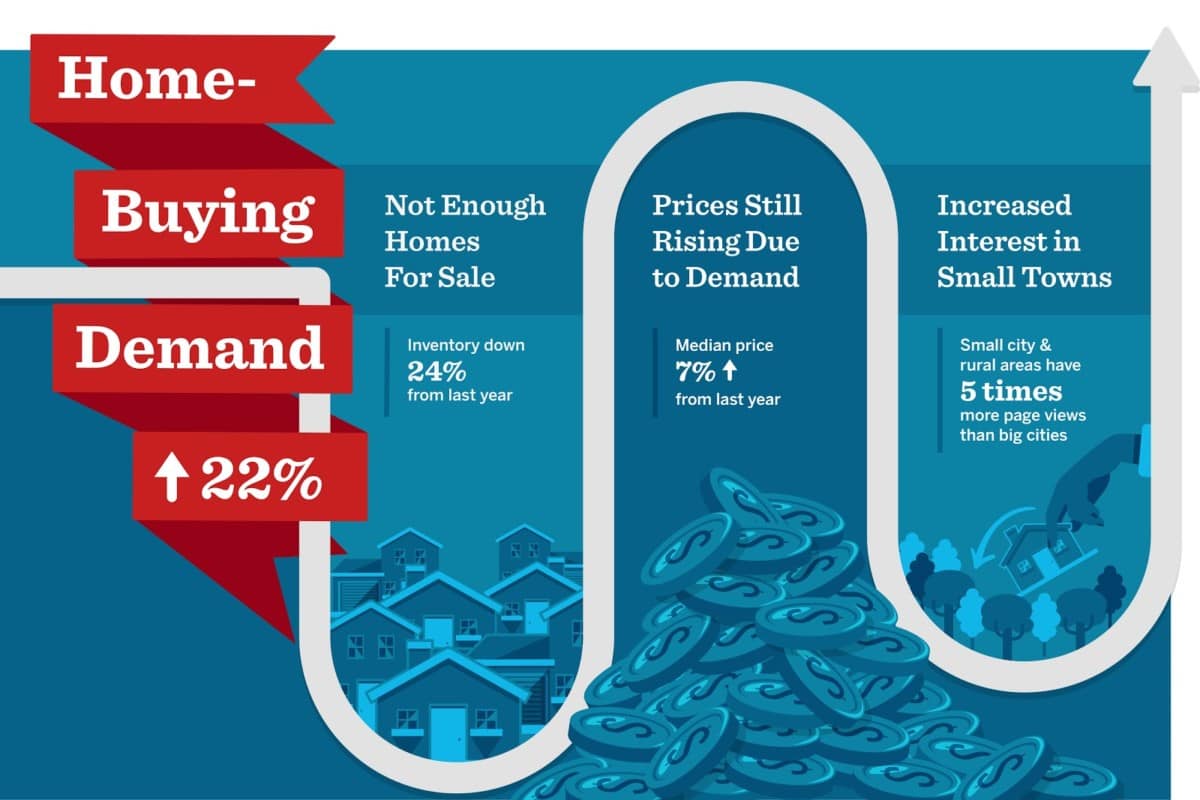
Home-Buying Demand up 22%

Just the Facts: Four Key Housing Market Takeaways for This Week

  • Home-buying demand is up 22% from pre-pandemic levels after seven straight weeks of gains.
  • Sellers are slowly returning, but new inventory can’t keep pace with demand and the number of homes for sale is down 24% compared to the prior year.
  • Mortgage rates near 3% and inventory shortages drove prices up 7% and have increased competition for homes. Noah Goldberg, a Redfin agent in New Jersey said, “I was working with a buyer to purchase a home for over a million dollars that had been on the market more than 100 days. We’d negotiated a good deal and out of nowhere another buyer swooped in and bid it up.”
  • Rising prices and the freedom to work from home are causing buyers to reconsider their options. Pageviews on Redfin.com for cities under 50,000 people and rural areas are growing 5x faster than pageviews for cities with more than one million people.

Home-buying demand up seven straight weeks

It’s a difficult time to be reporting on the recovery in the housing market while the country grieves over the unjust killings of George Floyd, Breonna Taylor, Ahmaud Arbery and many others. In cities across the nation, Americans marched to protest systemic racism and a long history of violence and brutality targeted at Black people in America. Redfin supports the protests, and we know we need to do more to help end the cycle of racism in America.

We decided to publish this week’s update, because we also feel an obligation to people who are trying to decide whether to buy or sell a house; to drop their home’s price or hold out for a better offer; to make decisions about what is generally people’s largest financial investment.

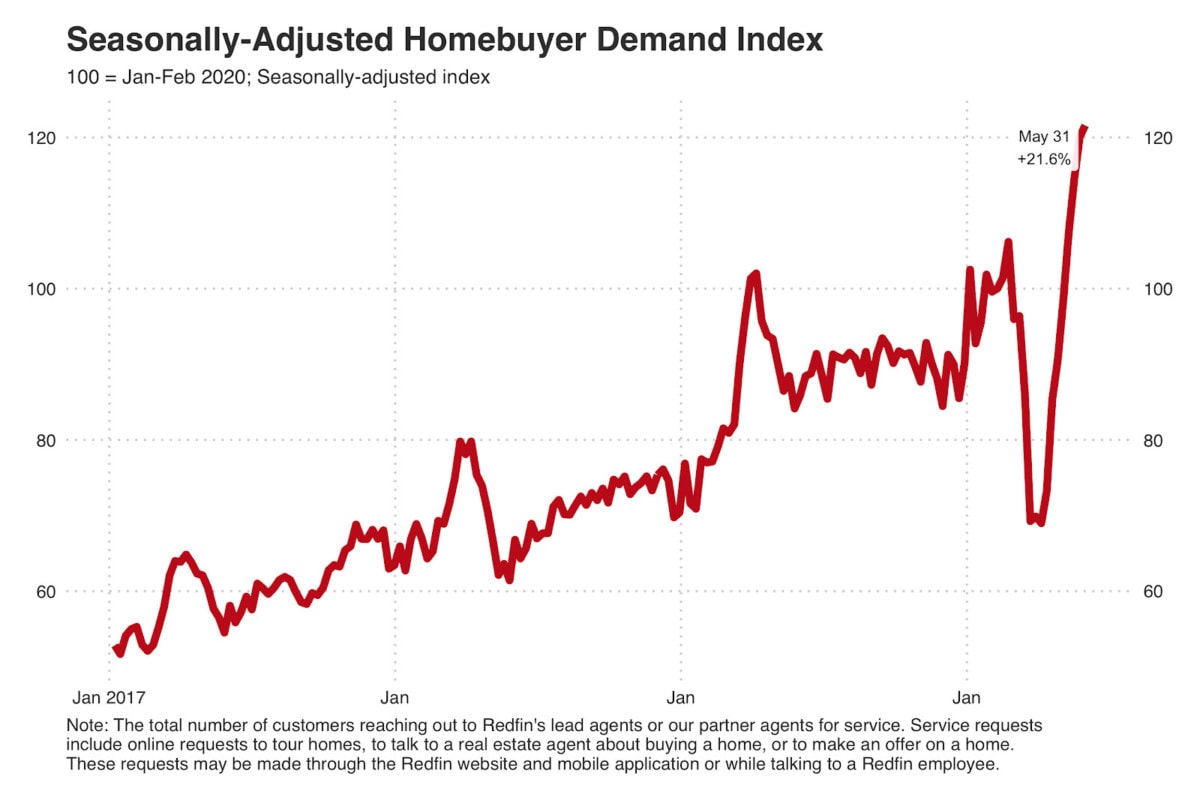
For the full week ended May 31, demand was up 22% from pre-pandemic levels in January and February, on a seasonally-adjusted basis. This marks the seventh straight week Redfin’s home-buying demand has increased since it hit bottom in mid-April.

Redfin Homebuyer Demand Index

When looking at demand on a daily basis, Redfin’s home-buying demand peaked on Thursday May 28, at 25% above pre-pandemic levels on a seasonally-adjusted basis. By Sunday, May 31 it was up only 17%. Whether people were out protesting, watching the news, or following the curfews that were imposed in many cities, national attention shifted away from home-buying in the second half of the week.

If curfews are lifted and streets are re-opened by next week, we should have a clearer view on whether homebuyers will return to the market with the same energy they had previously, or whether there will be longer-lasting effects on home-buying demand.

Sellers who don’t have to sell are starting to join the market

During the height of the pandemic, very few people who didn’t have to sell put their homes up for sale. Now we’re starting to see a resurgence in sellers who want to sell. Mary Bazargan, a Redfin listing agent in Washington, D.C. said, “It’s a mix. About half of my sellers are moving for a new job or heading out to the suburbs for a bigger home. But a lot of them are landlords that just don’t want to deal with it any more.”

Over the past few years, rising rents and rock-bottom interest rates have made it attractive for home-owners to keep their old place and rent it out rather than sell it, but now many sellers may be looking to simplify their lives as they adapt to life during the pandemic.

Despite the increased interest in selling, new listings were still down 22% for the week ended May 31 compared to the same week last year. Many sellers who do decide to list still have health concerns about buyers in their homes. Some sellers are choosing to move out for the first week or two, heading to the in-laws or to an airbnb, and hoping to catch a buyer before they have to come back.

Prices are up because listings still can’t keep up with buyer demand

After seven straight weeks of gains in home-buying demand and sellers returning to the market more cautiously, the total number of homes for sale was down 24% for the week ended May 31 compared to the same week last year.

Noah Goldberg, a Redfin agent in New Jersey said, “The competitiveness in the market has picked up noticeably. I was working with a buyer to purchase a home for over a million dollars that had been on the market more than 100 days. We’d negotiated a good deal and out of nowhere another buyer swooped in and bid it up.”

Low mortgage rates are motivating many buyers to move now. Rates for a 30-year fixed-rate mortgage are still hovering near all-time lows around 3%, keeping down monthly payments even as prices rise. The median sale price for the week ended May 24 was up 2% compared to the same week the prior year. That is a smaller gain than we’ve seen in recent weeks, but it’s notable because most of those deals were struck in mid-April when the pandemic was at its height.

Looking ahead, the median asking price for new listings is up 7% for the week ended May 31 compared to the same week last year. There’s a good chance sale price gains in late June and July will accelerate as the homes hitting the market now start to sell.

Rising prices and working from home give buyers the motivation and opportunity to get creative

To contend with rising home prices, we’re hearing more stories of buyers purchasing a home with space for their parents or moving in near family to be closer to help with the kids. People are trading a condo in LA for a single-family home in Dallas, selling in D.C. and heading to Atlanta, or moving from Denver to Detroit.

In many cases, buyers aren’t looking in big cities, at all. In April and May, pageviews on Redfin.com for homes in cities with less than 50,000 residents and rural areas are growing five times faster than pageviews for homes in cities and suburbs with more than a million people.

As more companies embrace fully-remote or part-time work-from-home policies, buyers are willing to move a little further away from the office, looking for a bigger home and more outdoor space. Mike Welk, a RedfinNow asset manager in Denver, said, “I am hearing a lot more from people who are looking further out of Denver. They think, ‘If I only have to go into the office three days a week, I can drive an extra 10-15 miles, save a bundle, and get a bigger place.’”

Facebooktwitterpinterestlinkedin

NAR: Contract Signings Likely Won’t Go Any Lower | #YajneshRai #01924991 #TeamYaj #SangeetaRai #02026129

Facebooktwitterpinterestlinkedin

NAR: Contract Signings Likely Won’t Go Any Lower | Realtor Magazine

The COVID-19 pandemic hampered home sales contracts in April, but that will likely mark the low point in pending home sales for the year, according to the National Association of REALTORS®’ latest housing report released on Thursday. April was the second consecutive month of declining pending home sales, as social distancing measures and widespread business closures mounted due to the igniting coronavirus outbreak. Every major region of the country saw a drop in month-over-month contract activity in April.

NAR’s Pending Home Sales Index—a forward-looking indicator of home sales based on contract signings—fell 21.8% in April. Contract signings were 33.8% down for the year. April’s decline also marked the greatest decrease in pending home sales since NAR began tracking such data in January 2001.

“With nearly all states under stay-at-home in April, it is no surprise to see the markedly reduced activity in signing contracts for home purchases,” says Lawrence Yun, NAR’s chief economist.

Yun expects April’s pending home sales to be the lowest point for the year, and the month of May to, therefore, be the lowest point for closed sales. He then predicts a rebound in the housing market in the summer months.

“While the coronavirus mitigation efforts have disrupted contract signings, the real estate industry is ‘hot’ in affordable price points with the wide prevalence of bidding wars for the limited inventory,” Yun says. “In the coming months, buying activity will rise as states reopen and more consumers feel comfortable about home buying in the midst of the social distancing measures.”

More reason behind housing’s optimism: Mortgage applications have been rising over the last few weeks, a gauge used to measure future home sales.

“Given the surprising resiliency of the housing market in the midst of the pandemic, the outlook for the remainder of the year has been upgraded for both home sales and prices, with home sales to decline by only 11% in 2020 with the median home price projected to increase by 4%,” Yun says. “In the prior forecast, sales were expected to fall by 15% and there was no increase in home price.”


NAR Pending home sales Apr. 2020. Visit source link at the end of this article for more information.

© National Association of REALTORS®

Facebooktwitterpinterestlinkedin

Mortgage Rates Tick Up Slightly After Last Week’s Record Low | #YajneshRai #01924991 #TeamYaj #SangeetaRai #02026129

Facebooktwitterpinterestlinkedin

Mortgage Rates Tick Up Slightly After Last Week’s Record Low | Realtor Magazine

Mortgage rates for 30, 15, ARM. Full information at http://www.freddiemac.com/pmms/

© REALTOR® MAGAZINE

The 30-year fixed-rate mortgage inched up after reaching an all-time low last week. However, mortgage rates continue to hover near the lowest averages ever recorded by mortgage financing giant Freddie Mac.

The 30-year fixed-rate mortgage averaged 3.18% this week, up slightly from last week’s all-time low of 3.15%.

“While the economy is slowly rebounding, all signs continue to point to a solid recovery in home sales activity heading into the summer as prospective buyers jump back into the market,” says Sam Khater, Freddie Mac’s chief economist. “While home buyer demand is up and has been broad-based across most geographies, supply has been slower to improve. In fact, the gap between supply and demand has widened even further than the large gap that existed prior to the pandemic.”

Freddie Mac reports the following national averages with mortgage rates for the week ending June 4:

  • 30-year fixed-rate mortgages: averaged 3.18%, with an average 0.7 point, rising from last week’s 3.15% average. Last year at this time, 30-year rates averaged 3.82%.
  • 15-year fixed-rate mortgages: averaged 2.62%, with an average 0.7 point, unchanged from last week. A year ago, 15-year rates averaged 3.28%.
  • 5-year hybrid adjustable-rate mortgages: averaged 3.10%, with an average 0.4 point, falling from last week’s 3.13% average. A year ago, 5-year ARMs averaged 3.52%.

Freddie Mac reports average commitment rates with average fees and points to reflect the total upfront cost of obtaining the mortgage.

Facebooktwitterpinterestlinkedin

Mortgage Applications Jump 18% Amid Record Low Rates | #YajneshRai #01924991 #TeamYaj #SangeetaRai #02026129

Facebooktwitterpinterestlinkedin

Mortgage Applications Jump 18% Amid Record Low Rates | Realtor Magazine

Mortgage rates again fell to an all-time low last week and home buyers are rushing out to take advantage. Mortgage applications to purchase a home rose 5% last week, putting applications for home purchases 18% higher than a year ago, the Mortgage Bankers Association reports from its seasonally adjusted index.

This marks a strong rebound in applications. Six weeks ago, the COVID-19 outbreak brought mortgage applications down 35% compared to last year.

As states reopen, more home buyers are entering the housing market. Mortgage application indexes are viewed as a gauge for future home-buying activity.

“The pent-up demand from home buyers returning to the market continues to support a recovery from the weekly declines observed earlier this spring,” says Joel Kan, an MBA economist. “However, there are still many households affected by the widespread job losses and current economic downturn. High unemployment and low housing supply may restrain a more meaningful rebound in purchase applications in the coming months.”

The average contract interest rate for a 30-year fixed-rate mortgage decreased to a record low last week—3.37%, the MBA reports.

The low rates are proving a boon for the purchase market but aren’t drawing out more refinancers. Mortgage applications to refinance a home dropped 9% last week, marking the seventh consecutive week of the decline. That said, refinance applications are still 137% higher than a year ago, when interest rates were 86 basis points higher.

Facebooktwitterpinterestlinkedin

Home Design That Promotes a Healthy Lifestyle | #YajneshRai #01924991 #TeamYaj #SangeetaRai #02026129

Facebooktwitterpinterestlinkedin

Home Design That Promotes a Healthy Lifestyle | Realtor Magazine

Hospital design and the food industry could teach the residential real estate community a lot when it comes to creating healthier space, says Bea Spolidoro, principal at FisherARCHitecture in Pittsburgh. A person’s home can have a physical and psychological health impact, Spolidoro told Forbes.com.

Spolidoro says homes can be designed to limit the spread of germs and bacteria with flatter, smoother surfaces that are easier to clean. Spolidoro recommends reducing seams in countertops, ensuring nothing can easily fall behind built-in cabinetry, and avoiding overly complicated designs in high-touch surfaces such as doorknobs, handles, buttons, operating parts, and railings.

Nonporous materials are easier to clean and sanitize, such as steel, quartz, and Corian. On the other hand, granite and other natural stone countertop surfaces are more porous and can allow for microbial spores to accumulate. Look for materials that have natural antimicrobial properties, such as copper and its alloys—brasses, bronzes, copper, nickel, and zinc, among others.

Also, proper ventilation is important in reducing the spread of bacteria, limiting the accumulation of pollutants inside and outside a home, which can affect those with respiratory problems. Several indoor air quality monitors can help track levels of pollutants. Additionally, outdoor air quality monitors can warn when windows should be closed. Air purifiers and even some indoor plants also can help improve the air quality inside a home.

Facebooktwitterpinterestlinkedin