5 Tips for Prepping a Lawn for the Winter | #LawnTips #TalkToYourAgent #SiliconValleyAgent #YajneshRai #01924991 #YourAgentMatters #TeamYaj #SangeetaRai #02026129

Facebooktwitterpinterestlinkedin

5 Tips for Prepping a Lawn for the Winter | Realtor Magazine

How homeowners treat a yard this autumn can determine the quality of their yard next spring and summer. Kris Kiser, president and CEO of the Outdoor Power Equipment Institute, offers up the following checklist for homeowners who want to lay a strong groundwork for a great yard next spring:

Keep mowing. Grass still needs regular care to stay healthy. Grass that is too high may attract lawn-damaging field mice. Shorter grass is more resistant to diseases and traps fewer falling leaves. Cutting the grass low also allows more sun to reach the crown of the grass. However, cutting off too much at one time can be damaging, so never trim more than a third of the grass blades off in a single cutting, Kiser says. Put mower blades on the lowest settings for the last two cuts of the season.

Aerate your lawn. Compressed soil can hurt the health of the grass. Aerating punches holes in the soil and lets oxygen, water, and nutrients into a lawn. Use a walk-behind aerator or get an attachment to pull behind a riding mower, Kiser suggests.

Mulch your leaves. Many mowers can mulch leaves with an attachment. Since mulching with a mower can mix grass clippings with leaf particles, these nitrogen-rich grass particles and carbon-rich leaf particles will compost more quickly. They can then return nutrients to the soil.

Trim and shore up trees and bushes. Use trimmers, chainsaws, or pole pruners to cut back trees, shrubs, and plants. Make sure branches are safely trimmed back from overhead lines and not in danger of falling on a home or structure in winter weather. You may need to tie or brace limbs of upright evergreens or plants to prevent them from breaking in high winds or snow. Call a professional arborist for big trees or hard-to-reach spots.

Repair bald spots. Fall is a great time to patch bald or thin spots in a lawn. The easiest way to do this is with an all-in-one lawn repair mixture (found at most garden shops and home centers), Kiser says. Use a garden rake or dethatcher to scratch loose the soil on the spot.

Facebooktwitterpinterestlinkedin

A Fix or a Flop? When DIY Home Renovation Turns Iffy | #TipsForRenovation #TalkToYourAgent #SiliconValleyAgent #YajneshRai #01924991 #YourAgentMatters #TeamYaj #SangeetaRai #02026129

Facebooktwitterpinterestlinkedin

A Fix or a Flop? When DIY Home Renovation Turns Iffy | Realtor Magazine

Some homeowners take on more than they should with do-it-yourself home projects. They could wind up hurting their home value.

Homeowners hope to save money through DIY takes on projects, but some lose that savings when they sell. Chicago-area home inspectors recently shared withThe Chicago Tribunesome of the common DIY mishaps they most often see, including:

Using online videos as tutorials.

Homeowners may follow an online tutorial to install a bathroom sink or kitchen sink that can ultimately end up in disaster, inspectors say. “The hot water is always on your left and the cold is always on your right, but when you’re lying on your back underneath, they look backwards, so people install the hot on the right and the cold on the left,” Jeff Merritt, a Chicago home inspector who runs Homestead Inspections, toldThe Chicago Tribune. Homeowners may rely too much on YouTube videos by amateurs to guide them through house projects. When using online tutorials, homeowners should ensure the tutorial illustrates exactly what they want to do and to check with additional sources to confirm industry standards, inspectors say.

Assuming basement projects are easy.

Finishing off a basement is a common DIY project, but it can also cause a lot of trouble for homeowners who don’t do their homework. “If you’re not doing the proper work, you’ll get dampness, puddling, and seepage,” says William Decker, the owner of Decker Inspection Services in Skokie, Ill. “And any time you have water and cellulose together, you’re going to get mold.” Inspectors say their suspicions are raised that mold or a damp basement may have been present or covered up when there’s newly replaced wood and new paint.

Failing to take into account air quality and venting.

Inspectors say an amateur mistake they see often is to vent exhaust fans and appliances into attics or the garage instead of outside. Venting warm and often moist air into an enclosed space can cause mold and wood rot. The air needs to be vented outside. Also, sealing vents at the roof line often requires professional attention, inspectors say.

Failing to keep documented records.

Homeowners should keep detailed records of the materials, receipts, and permits to all the improvements and maintenance projects they do, whether DIY or professional. “Make sure that what you brag about [in listing descriptions] is documented,” Corey B. Stern, a partner at Chitkowski Law Offices, a real estate law firm in Lisle, Ill., told theTribune. “Make sure that what you brag about is documented. If the house has been on and off the market, look at the prior listing sheets and see if there’s new work.”

Facebooktwitterpinterestlinkedin

3 Home Lighting Mistakes to Avoid | #LightingTips #TalkToYourAgent #SiliconValleyAgent #YajneshRai #01924991 #YourAgentMatters #TeamYaj #SangeetaRai #02026129

Facebooktwitterpinterestlinkedin

3 Home Lighting Mistakes to Avoid | Realtor Magazine

Good lighting can enhance the look of a space. Houzz.com contributor David Warfel, a lighting design specialist, recently shared the common mistakes he sees with interior home lighting in an article on the home remodeling website. Problems he sees the most often include:

Too many lights shining downwards in the kitchen

Warfel notes that many kitchens have more light shining on the floor than on the countertops, where it has the biggest impact. “Adding well-positioned recessed lights, pendant lights above islands, and under-cabinet lighting are among the ways to ensure our kitchen work areas have enough light,” he notes.


Failing to illuminate distinct details

Light in most homes tends to spotlight the drywall, the least expensive surface in a home, Warfel notes. “Instead, position lights to selectively illuminate other details such as molding, arches, and shelves,” he writes. For example, highlight the stone walls in a living room, such as by placing light directly above the face of the stone and having the light graze down the wall.


Harsh lights on a bathroom vanity

Warfel says it’s best to avoid poor bathroom vanity lighting. It will cast deep shadows under your eyes and chin. Wall sconces can be a stylish solution and provide a softer glow.

Facebooktwitterpinterestlinkedin

5 Easy Ways to Transform Cabinets When Painting Isn’t an Option | #PaintingTips #TalkToYourAgent #SiliconValleyAgent #YajneshRai #01924991 #YourAgentMatters #TeamYaj #SangeetaRai #02026129

Facebooktwitterpinterestlinkedin

5 Easy Ways to Transform Cabinets When Painting Isn’t an Option | www.nar.realtor

We’ve all been there: You tour a home with a great address and inviting floorplan—but those cabinets, though! They glow with an orange or red tint. The floors may even match the cabinetry. Dated oak or maple cabinets, if they could talk, may scream to a potential buyer: “Big renovation project needed! Not move-in ready!”

Cabinets matter. Light and white remain preferable to buyers, confirms a survey from Home Stratosphere(link is external), a home décor blog that surveyed thousands of consumers about their color of choice for kitchen cabinetry. White is by far the most popular cabinet color. 

Painting cabinets can dramatically improve a room and update the overall impression of a home with a more modern finish. But a seller may not always have the extra funds to take on painting the cabinets prior to listing the home. (Expect a price tag of $3,000 or more.) 

So what do you do? Let’s take this example. 

Kitchen with island, and pine colored cabinets

When painting cabinets is not an option, try these five staging tips to transform the look.

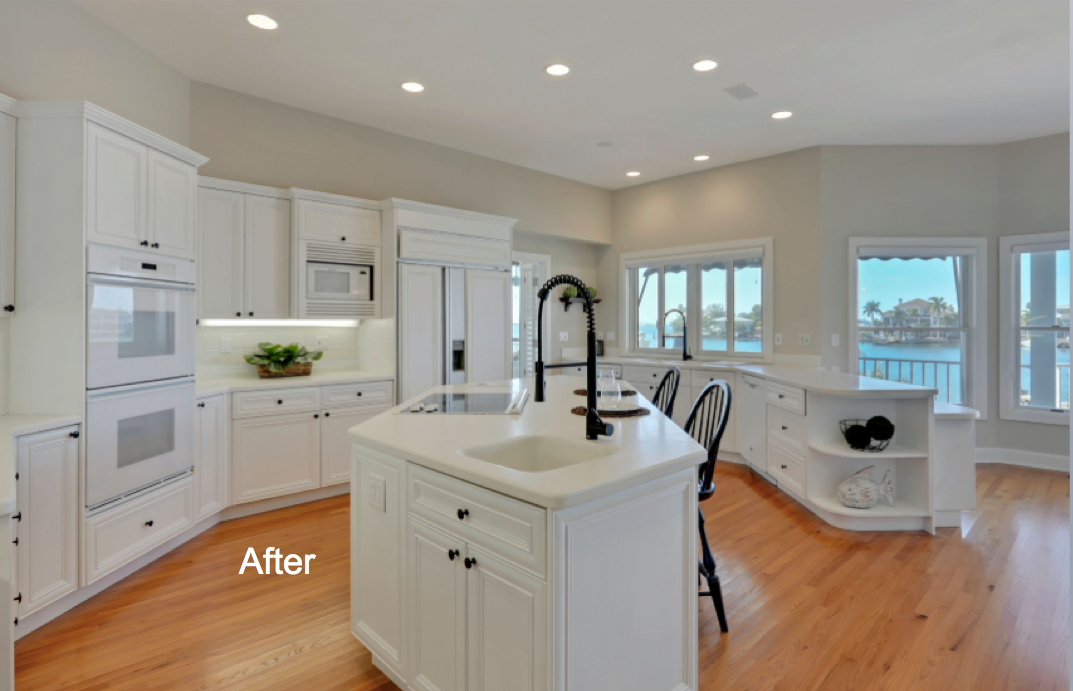
A Kitchen with island, and white cabinets with light colored hardwood floor

Photo Credit: Karen Post, Home Frosting

Just paint the island, or add an island with white or metal. This small change costs significantly less, is not as disruptive, and can still have a high impact on the room’s look.

Neutralize dark or bold colors. Tone the cabinets down by adding large white accessories, such as hand towels, big bowls, and trays.

Change out the lighting. Try updating a key decorative light fixture. It can make dated cabinets feel more current. Also, swap out the light bulbs for warmer options, such as a soft white (in the 2700K to 3000K range).

Show prospects some what-ifs. Many of the national paint companies offer tools to show how a new paint color can change a room. This includes cabinets. Drop in your photos and digitally repaint them to show prospective buyers the possibilities for when they move in. 

Before image of kitchen with standard "Warm" lighting
A Kitchen being shown in cool lighting

Photo credit Karen Post, Home Frosting

Have quotes on-hand. Invite a cabinet repainting company to submit a cost and time estimate of refinishing the cabinets. You can use this as a price negotiation point or provide a new buyer with an allowance to get this change completed before they move in.

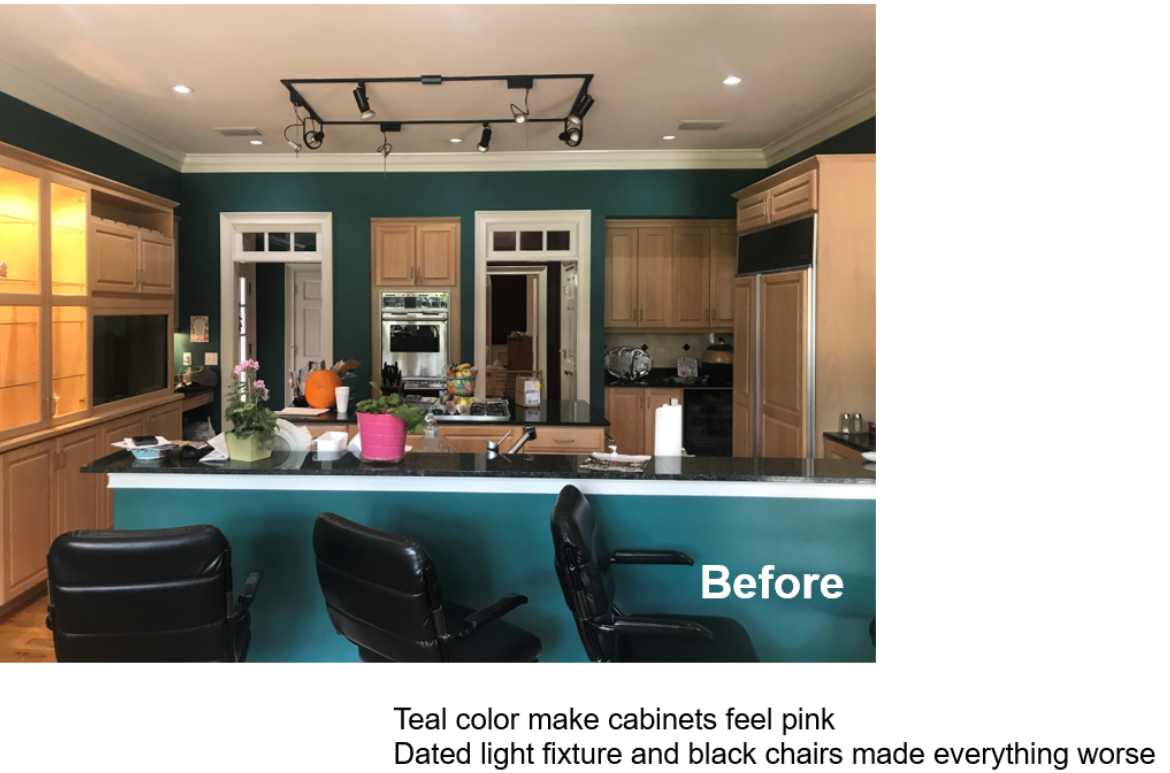
Check out the pictures below of another before-and-after set of picture to see how these ideas work.

Kitchen with teal cabinets
A kitchen with pendant lighting and white cabinets

Photo credit Karen Post, Home Frosting


Facebooktwitterpinterestlinkedin

4 Overlooked Areas That Make a Big Difference in Staging | #StagingTips #TalkToYourAgent #SiliconValleyAgent #YajneshRai #01924991 #YourAgentMatters #TeamYaj #SangeetaRai #02026129

Facebooktwitterpinterestlinkedin

4 Overlooked Areas That Make a Big Difference in Staging | Realtor Magazine

When you’re staging properties for resale, you likely target all the main areas: decluttering the home, adding some fresh flowers, and fluffing the pillows. But realtor.com® recently highlighted some other areas that are often overlooked when staging but can still make a big impact, including:

Tend to the mailbox.

Repaint the mailbox or make any repairs, particularly if it’s showing its age or leaning. “Replace the mailbox—literally the first thing people see,” Teris Pantazes, CEO and co-founder of SettleRite, a home improvement company in Baltimore, told realtor.com®.

Reglaze.

A reglaze of the tile or in the bathroom can give a modern update to a space. “The best tip I use to get top dollar for some of our houses is to reglaze an old bathroom that has a terrible color of tile—like pink or green,” Michael Pinter, a home flipper with LMPK Properties in Long Island, N.Y., told realtor.com®. “We reglaze the bathroom white for a few hundred dollars, and a dated bathroom will look 30 years younger.”

Restore rooms to their purpose.

Make sure the spaces in the home are being used for their original purpose. As such, the dining room that is currently being used for a kid’s playroom should be restaged. “Buyers want to see the space used in a traditional way—with a dining table in the dining room, a desk and chair in the office—to envision themselves living there,” realtor.com® notes.

Sell the love.

Don’t forget to sell the love and appreciation of a home. Russell Volk, a real estate pro with RE/MAX Elite in Bucks County, Pa., once had the home sellers write a one-page letter about the life in the house. “Their story of how they raised their family and what kind of experiences they had in the home was very personal and emotional,” says Volk. He framed the letter and placed it on the kitchen counter for potential buyers to read. “If sellers can connect with buyers on an emotional level, chances of buyers paying top dollar for the house drastically increase,” says Volk.

Facebooktwitterpinterestlinkedin

Mortgage Rates Tick Up Slightly This Week | #InterestChangesGear #TalkToYourAgent #SiliconValleyAgent #YajneshRai #01924991 #YourAgentMatters #TeamYaj #SangeetaRai #02026129

Facebooktwitterpinterestlinkedin

Mortgage Rates Tick Up Slightly This Week | Realtor Magazine

Mortgage rates for 30, 15, ARM. Full information at http://www.freddiemac.com/pmms/

© REALTOR® MAGAZINE


The 30-year fixed-rate mortgage inched up this week, but still remains well below averages from a year ago.

The 30-year fixed-rate mortgage closed the month of August by averaging 3.6%, nearly a full percent lower than a year ago, Freddie Mac notes.

“Low mortgage rates along with a strong labor market are fueling the consumer-driven economy by boosting their purchasing power, which will certainly support housing market activity in the coming months,” says Sam Khater, Freddie Mac’s chief economist.

Freddie Mac reports the following averages with mortgage rates for the week ending Aug. 29:

  • 30-year fixed-rate mortgages: averaged 3.58%, with an average 0.5 point, rising from last week’s 3.55% average. Last year at this time, 30-year rates averaged 4.52%.
  • 15-year fixed-rate mortgages: averaged 3.06%, with an average 0.5 point, rising from last week’s 3.03% average. A year ago, 15-year rates averaged 3.97%.
  • 5-year hybrid adjustable-rate mortgages: averaged 3.31%, with an average 0.4 point, dropping from last week’s 3.32% average. A year ago, 5-year ARMs averaged 3.85%.
Facebooktwitterpinterestlinkedin

Recession Fears Grow, But Economists Say Housing Is OK | #REOKAY #TalkToYourAgent #SiliconValleyAgent #YajneshRai #01924991 #YourAgentMatters #TeamYaj #SangeetaRai #02026129

Facebooktwitterpinterestlinkedin

Recession Fears Grow, But Economists Say Housing Is OK | Realtor Magazine

Recession fears are growing, and that may prompt some Americans—who are still haunted by the last one—to get skittish about the housing market. Don’t expect another “real estate fire sale” if the economy heads into another recession, economists say.

“This is going to be a much shorter recession than the last one,” George Ratiu, senior economist with realtor.com®, notes in a recent article at the site. “I don’t think the next recession will be a repeat of 2008. … The housing market is in a better position.”

Just 2% of economists, strategists, academics, and policymakers surveyed believe a recession will occur this year, based on a survey of more than 200 members of the National Association for Business Economics. Thirty-eight percent believe a recession will begin in 2020, while 25% say by 2021. Fourteen percent don’t expect a recession until after 2021.

The market still has plenty of good signs for home shoppers. The Federal Reserve has strongly hinted that another interest rate cut is looming in September, which could help bring mortgage rates down even lower. Unemployment continues to hover around the lowest it’s been in the past 50 years. Wages are also growing, and the country continues to be within its longest economic expansion in U.S. history.

If the country does enter into a recession, will home prices plunge like they did during the Great Recession? Many economists don’t believe so.

Ratiu believes home prices could flatten in a recession, but they likely wouldn’t drop. A shortage of homes for sale and a low amount being built should cushion any slowdown in the economy up against buyer demand, economists note. Also, lending laws have tightened since the housing crisis and borrowers are more qualified in securing a mortgage, notes Lawrence Yun, chief economist at the National Association of REALTORS®. Also, homeowners nowadays have a record amount of equity in their homes, so even if they lose their job they likely would be less inclined to head right into foreclosure and more likely to list their home for sale.

Still, the American psyche may play a bigger role if the country hits another recession. “With people having PTSD from the last time, they’re still afraid of buying at the wrong time,” Ali Wolf, director of economic research at Meyers Research, told realtor.com®. “But prices aren’t likely to fall 50% like they did last time.”

Facebooktwitterpinterestlinkedin

Is That Fixer-Upper Really a Good Deal? | #BePrepared #TalkToYourAgent #SiliconValleyAgent #YajneshRai #01924991 #YourAgentMatters #TeamYaj #SangeetaRai #02026129

Facebooktwitterpinterestlinkedin

Is That Fixer-Upper Really a Good Deal? | Realtor Magazine

The lower price of a fixer-upper and the added resale value after a remodel can be alluring to some home buyers. For example, the average price of a fixer-upper home on the TV show “Fixer Upper,” based in Waco, Texas, is $178,449, with the average resale value being $297,488.

But a new study from the remodeling site Porch.com, based on a survey of more than 1,000 homeowners, shows that the majority of fixer-upper homeowners who thought they could save money actually ended up spending about the same or more than a move-in ready home.

Respondents paid, on average, slightly over $250,000 for move-in ready homes. They paid slightly under $200,000 for a fixer-upper. But after the renovations, fixer-upper homeowners ultimately spent nearly $247,000—for those who managed to stay within budget. For those who went over budget—which about 44% said they did—they spent over $25,000 more than move-in ready buyers for a total of $275,741, according to the study.

Still, fixer-upper home buyers have no regrets. Eighty-six percent of homeowners who spent what they thought they would on renovations would buy the same house again. On the other hand, 60% of those who went over budget still would buy the same house too. Regretful fixer-upper homeowners say they would spend more time on inspections and be sure to get better cost estimates for the repairs their home needed.

Staying within budget seems to be the biggest challenge for fixer-upper homeowners. Forty-four percent of respondents said they went over budget on their fixer-upper. The most common projects that made them go over budget were a new HVAC, plumbing, basement, bathroom, new appliances, a new roof, or kitchen.


Porch.com fixer upper chart.Visit source link at the end of this article for more information.

© Porch.com

Facebooktwitterpinterestlinkedin

Home Inspectors List 3 Maintenance No-Nos | #InspectionImportant #TalkToYourAgent #SiliconValleyAgent #YajneshRai #01924991 #YourAgentMatters #TeamYaj #SangeetaRai #02026129

Facebooktwitterpinterestlinkedin

Home Inspectors List 3 Maintenance No-Nos | Realtor Magazine

From water damage cover-ups to dismissing small foundation cracks, homeowners may be trying to hide certain household issues. But a little routine maintenance can help prevent some situations from becoming bigger issues.

Home inspectors recently chimed in on Apartment Therapy with the most prevalent maintenance mistakes they see in properties all of the time, including:

1. Painting over water damage.

A fresh coat of paint can help work wonders in a property but it won’t fool a home inspector. John Mease, a home inspector in Atlanta, notices homeowners paint over water damage in a lot of properties he inspects. The most common areas he sees are surrounding a shower in a bathroom or on a ceiling. Water damage can be a sign of leaks. If rotted wood is behind the fresh coat of paint, the paint often will promote more rot and not fix it, home inspectors warn. Only once the leak is fixed should homeowners paint over the damage. Bob Vila recommends first cleaning the stain with bleach, apply a coat of stain-blocking primer, and then paint over it.

2. Failing to change the HVAC filter.

The longer homeowners go between changing their HVAC filters, the more stress they can put on their system. This can cause more debris to build up in the vents and ducts too, according to Cristina Miguelez of Fixr.com. Instead, homeowners should change their filters about once a month if they have pets or use their HVAC system every day. They can swap it out every three months in other scenarios, experts recommend.

3. Disregarding small foundation cracks.

Even a small crack in the foundation could prove problematic. “If a dime can fit into the crack, it could potentially lead to significant basement leaks,” Chuck Naish, founder of City Residential Foundation Center in Ottawa, Canada, told Apartment Therapy. He recommends homeowners fix any small foundation cracks—at least 1/8’’—with spray or waterproofing paint. For anything bigger or if any doubts, he recommends calling in a professional to take a look.

Facebooktwitterpinterestlinkedin

Behr Reveals Its Pick for 2020 Color of the Year | #2020Color #TalkToYourAgent #SiliconValleyAgent #YajneshRai #01924991 #YourAgentMatters #TeamYaj #SangeetaRai #02026129

Facebooktwitterpinterestlinkedin

Behr Reveals Its Pick for 2020 Color of the Year | Realtor Magazine

A meadow-inspired green is paint firm Behr’s top pick for the 2020 Color of the Year. Color forecasters expect the hue, called “Back to Nature,” to surface in more home interiors over the next year to bring a sense of the outdoors to the indoors.

“As we look ahead to a new decade, Back To Nature encourages us to reengage with the natural world, which we know can have a real, positive impact on our well-being,” says Erika Woelfel, vice president of color and creative services at Behr. “Everyone has a different way of engaging with nature. Whether you’re biking on a forest path, canoeing on a lake, or walking on the beach, green is prevalent in nearly every outdoor landscape. It is easily nature’s favorite color.”

The yellow-based green brings “tranquility” to a space, whether on the wall of a living room or throw pillows in a bedroom, Behr says. Earlier this year, Behr released its 2020 Color Trends palette, which is based on global color trend research for residential and commercial settings. The palette consists of 15 colors, including Back to Nature

“Back to Nature serves as the cornerstone to this collection,” Woelfel says. “It can work hand in hand with simple or maximal styling, whether your goal is to transform kitchen cabinetry with a new neutral look that feels unique and fresh or simply make a small space feel more open and airy.”

Adding a bold shade to furniture, cabinets, paneling, or window frames is a trend gaining popularity. For example, charcoal, touted in Behr’s color forecast, can be a bold accent color. In addition, hues like Rumba Orange for an interior door, Red Pepper for a brick fireplace, and Bluebird for a staircase are also spotlighted. “Adding color to ceilings and floors can draw the eye up or down, breathing new life into a space,” Behr notes.

Facebooktwitterpinterestlinkedin